Celebrating School-Wide Environmental Learning at Folger McKinsey ES

July 23rd, 2012 by Sue Rodger

Folger McKinsey second grade students seining.

At Folger McKinsey Elementary, our Maryland Green School and newly awarded National Green Ribbon status are part of the daily educational experience and integral to the culture that is fostered in and out of the classroom.  Dedicated to fostering life-long learners, the school capitalizes on every opportunity to promote environmental literacy.  “Being green” is much more than a few environmental science lessons and recycling.  It is part of the school culture in which lessons and activities that increase environmental understanding and responsibility are implemented whenever and wherever possible. In addition to grade level specific programs, school-wide educational activities allow students to experience the environment. Every little bit makes a difference…

The Greater Severna Park Watershed Action Group hosts an annual Earth Day Festival, drawing thousands to participate in environmental education.  Folger students and staff participate annually, both the day of with a demonstration and activity booth, as well as in the planning and implementation of the event.  Earth Day actually becomes “Earth Month” at Folger as the school gears up for the Festival, along with capitalizing on the popularity of the environment as a hot topic in April.  Each grade level creates or updates its tri-fold that is on display at the Festival.  Each grade highlights one environmental activity or concept that takes place at Folger throughout the year.  The PTO organizes volunteers to lead interactive games at the Folger booth, including the “Trash Challenge” and “Our Earth is in Jeopardy” quiz game.  Scout troops from the school created the banner for the booth.  As a result, the entire school takes part in making our school’s booth a reality.

At the recent Spring Concert, featuring the orchestra, band and chorus, parents were informed that there would no longer be a printed program in an effort to reduce paper and energy in creating it.

Read Across America Day celebrates reading by honoring Dr. Seuss and Folger makes this day special with “celebrity” guest readers in every class.  A “green” component was added to the event two years ago and it wasn’t eggs!  Instead, each student is asked to donate a gently-used book to be shared with a reading program in a neighboring area that seeks to get books in the hands of children who would not otherwise have access to reading materials.

The importance of recycling is highlighted with an annual classroom challenge.  Students are encouraged to bring in magazines and catalogs from home to be recycled at school.  The items are measured to track just how much paper is coming into our homes and to highlight how we can reduce this and why it’s crucial to recycle, rather than just throw in the trash.  The prize for the class that recycles the most is an extended recess with team-building games led by volunteers.  Being outside is a great place to learn – and this kind of prize instills a renewed appreciation for the earth.

America Recycles Day is gaining attention and it was added to the calendar at Folger. Parent volunteers met with all 22 classes on this Fall day to remind students about recycling in class and in the cafeteria.  Lessons focused on what is recyclable and the difference recycling makes to the environment.  Taking it a step further, the presentation also addressed reducing waste through packing re-usable lunches.  For participating, every student was entered into a raffle and all prizes promoted the environment:  t-shirts with “green” messages, pencils made from recyclable material and re-usable lunch boxes, containers, utensils and water bottles.  All of this reinforces the message and helps students to actually make the step in improving their actions.

Capitalizing on pop-culture, the popularity of The Lorax movie was integrated into the classroom at many grade levels.  For example, students made posters in which their faces were placed on the Lorax then asked what he/she does or will do to save the earth.  This activity engages students of all ages and instills in them the idea that they indeed make a difference and their actions and ideas matter.

Classroom lessons, field trips, activities, community partnerships – they all help to promote environmental stewardship at Folger.  The Maryland Green School flag and National Green Ribbon are not just on display at Folger McKinsey Elementary; they are a way of learning and green living. At Folger McKinsey Elementary School, we seize every opportunity to make the connection between traditional curriculum requirements with the natural world, using the environment as a valuable instructional tool to attain educational objectives, in part by simply getting outside.

Sue Rodger is a First Grade Teacher and is the Environmental Committee Chairman at Folger McKinsey Elementary School.

Greening all Grades at Folger McKinsey Elementary School

July 9th, 2012 by Sue Rodger

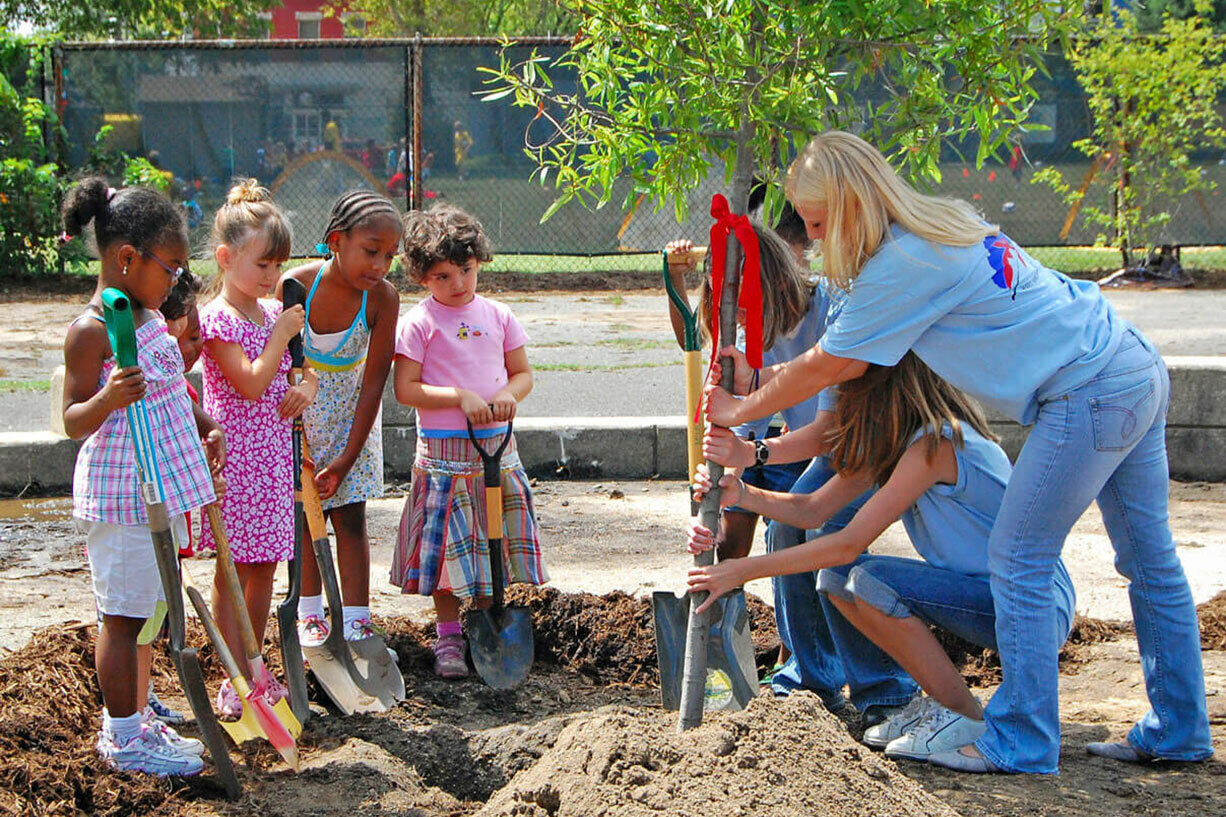
First grade students at Folger McKinsey plant milk-week and other plants for our butterfly garden.

Students at Folger McKinsey Elementary learn many environmental lessons in school that they put into practice on a daily basis, both at school and home because they all eat, breathe and sleep in the shadow of this great estuary.  As such, Folger staff recognizes the importance of instilling environmental stewardship and capitalize on the opportunity to promote such an understanding as often as possible.  This is done through classroom lessons across all disciplines. Folger students enjoy the many benefits of living and attending school in the Chesapeake Bay Watershed.  With privileges come responsibility and the Folger education includes many lessons in all grade levels that are geared toward developing ownership of that responsibility by creating life-long learners committed to environmental stewardship.

Kindergarten classes have been involved in recycling this year via daily use of the recycle bin in the classroom and recycling at lunch. Children participated in an environmental education trip to Camp Woodlands in which lessons about trees were taught. Students learned about the parts of trees, the functions of the parts, the life cycle of trees, and how trees benefit animals and humans. The visit culminated in a tree being planted at Folger’s temporary location, Chesapeake Bay Middle Schoo. Kindergarteners also participated in environmentally themed class science projects focusing on soil, decomposition, and recycling. Finally, Kindergarten monthly newsletters and homework are sent home electronically.

First grade has been doing a year-long study of the monarch butterfly. In the fall we got monarch caterpillars and raised them through all stages in our classroom tents. We released about 16 butterflies throughout the month of October. During the winter, we went to the greenhouse at CAT North where we did monarch activities and planted milk-week and other plants for our butterfly garden. In May, we planted these plants in our butterfly garden at our newly renovated school. In the fall, we will be able to find our own caterpillars from our butterfly garden and use the milk-weed leaves that we are growing to feed them.

Additionally, first grade raised two terrapins this year, as we have done for the past 6 or 7 years, through the head start program in conjunction with Arlington Echo and the MD Department of Natural Resources. First grade also learned about Integrated Pest Management (the use of natural processes of nature rather than pesticides) through study of a STEM unit called Marianna Becomes A Butterfly concentrating on Agricultural Engineering.

The 100+ students in second grade recently made their annual pilgrimage to the Smithsonian Environmental Research Center (SERC) in Edgewater, MD.  During the day, students engaged in numerous hands-on lessons to bear witness to the importance of the Chesapeake.  Lessons focused on habitat exploration of aquatic and terrestrial animals, plants, water and soil.  The kids had a great time seining in the Bay to see what kind of habitat the Bay truly is, as well as examining oyster shells and trees.  Lessons also focused on how people influence the ecosystem.  This was evident, for example, when kids compared Chesapeake oyster shells of today to those of 50 years ago.  They could appreciate the considerable difference in size and how over-fishing, development, and activities on the Bay have affected the oysters; and how that in turn has resulted in the poor water quality of the Bay.  Students made connections to where they live, knowing that the Magothy River received a “D” on its report card and that they are not allowed to swim in the river following rain due to the poor water quality.  The lessons did not stop with understanding the situation and history; students also learned about what they need to be doing to solve the problem. By exploring nature through such hands-on, outdoor learning, the students appreciate and respect the natural world of which they are a part and the role they play in improving it.

The third graders at Folger have worked hard this year to maintain a “green” classroom environment. Students are mindful about recycling throughout the school day, both in the classroom and cafeteria. They have utilized the technology our school provides to help eliminate the use of extra paper. Dry erase boards are used often in math, and to reduce the use of tissues or paper towels as erasers, they reuse old socks. Third graders have also learned in science about water conservation and the use of a compost pile.

A week before Thanksgiving, Folger McKinsey’s fourth grade took a trip to Arlington Echo. The students experienced education in an outdoor setting during a series of hands-on activities. They tested water clarity and the effects of runoff pollution and sought solutions to each of these local environmental problems. The students also took time to learn about local crops and made their own applesauce. The trip was a great way for the students to experience the concepts that they were learning in science and see the practical application of their studies. The students are now researching an environmental issue that they will propose a policy or law change to help resolve the problem.

In the fall of 2011, fifth graders were tasked with solving erosion and stormwater management in the neighborhood around the school.  Classroom instruction, via a presentation from an Arlington Echo Outdoor Education Specialist, introduced the students to the challenges of development in the area and the impact to the water quality and habitat of the Chesapeake Bay.  Provided with information about native plants, the students applied their math skills to create a budget and plotted a map using native plants to help with stormwater management. Students took a field trip up the road to actually plant trees and shrubs to address the real-world problem.  This environmental project included a STEM project-based activity.

These are just some of the many examples of our students actively learning about the environment.  At Folger McKinsey, students are inspired to be life-long learners taking action to serve the environment in which they live!

Sue Rodger is a First Grade Teacher and is the Environmental Committee Chairman at Folger McKinsey Elementary School.