Amazing Oysters Pop-Up Reef Lesson

July 23rd, 2010 by Krissy

Using their artistic and creative skills your students can make a 3-D oyster reef just like this one.

Amazing Oysters will show elementary students how to build a 3-D pop-up oyster reef.

Oysters are truly amazing creatures.  One mature oyster can filter up to 60 gallons of water a day and oyster reefs provide vital habitat for hundreds of bay critters.

For the same amount of space, oyster reefs can have 50 times the surface area of a flat bottom. These reefs build up, just like coral reefs, to provide nooks and crannies for worms, snails, sea squirts, sponges, small crabs, fish and even baby oysters to live in.

So the oyster reef ecosystem makes the perfect local subject to teach your students about topics like biodiversity, food webs, adaptations and predator-prey relationships.

A great starting point to study oyster reefs is to use the Amazing Oysters educational activity.  In this lesson, your students will construct their very own miniature ecosystem reef.

They will learn about the critters that make the reef their home and why reefs are such a vital habitat.  Students will also discover the threats to oyster reefs including disease (MSX and Dermo), pollution and over harvesting (waterman used to call oysters Chesapeake Gold).

To complete this activity you will need the following materials:
- Copies of the reef diagram
- Construction paper
- Scissors
- Pencils or pens
- Glue
- Crayons, markers or colored pencils
- Rulers

Get started teaching about the Amazing Oyster by downloading a copy of Amazing Oysters (pdf) or for hard copy call (804) 698-4320 or e-mail Virginia.Witmer@deq.virginia.gov.

Once you complete this activity with your class let us know how it went or how you would improve the lesson by leaving a comment below.

Additional Resources
Oyster Teaching Resources – Bay Backpack
Oyster Field Studies – Bay Backpack

Krissy Hopkins is part of the Chesapeake Bay Program's Fostering Stewardship Team and Education Workgroup.

Shoot and Share your Outdoor Moments

July 19th, 2010 by Cathy

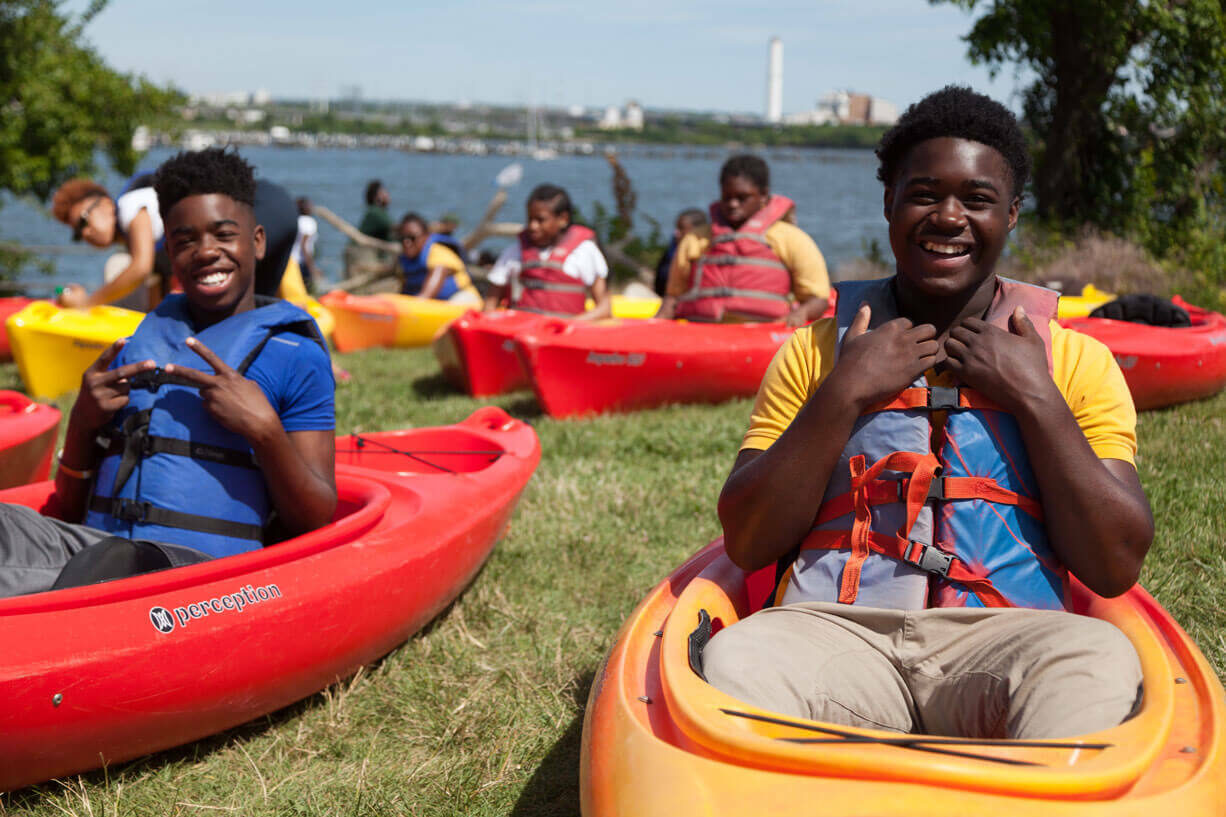
One of the images added to a group of Interns kayaking along the coastline.

The U.S. Fish & Wildlife Service is encouraging everyone to get out into nature and see some wildlife this summer with their Let’s Go Outside Campaign.  You can find nature in your backyard, at a local park or on a nearby national wildlife refuge.

Getting outside is a great way to create memories to last a lifetime.  More likely than not you will shoot pictures of these moments, so now you can share them online through Fish & Wildlife’s new Flickr group, Let’s Go Outside.  All you have to do is upload images of yourself or your students outside in nature.

You can even use Flickr’s Map function to identify where your photos were taken.  Along with adding your photos, you can also tell their stories by blogging about your experience with nature or chat on the discussion board about your favorite places to go.

Lets see how many we can get added in the Chesapeake region! Get out there and shoot and share!

Filed under: News,Teaching Resources
Tags:
Cathy Rezabeck the Regional Outreach Coordinator for U.S. Fish and Wildlife Service.

Why Teach About Sea Nettles?

July 12th, 2010 by Krissy
Sea nettles can be a pesky nuisance to swimmers in the summer months when their numbers soar.

Sea nettles can be a pesky nuisance to swimmers in the summer months when their numbers soar.

NOAA's sea nettle map shows the probably you will encounter jellies based on environmental conditions.

NOAA's sea nettle map shows the probably you will encounter jellies based on environmental conditions.

Sea nettles (Chrysaora quinquecirrha) are the most abundant jellyfish living in the Chesapeake Bay and its tidal tributaries. These stinging jellies have a smooth, milky white bell that usually grows to about four inches in diameter, with 24 stinging tentacles that hang from the inside of the bell.

Why should YOU teach about sea nettles?
Sea nettles have very particular habitat requirements making them a great critter to investigate in your classroom. Your students can become scientists by examining environmental conditions to predict when and where sea nettles will be present in the Chesapeake Bay.

Sea nettles prefer water temperatures ranging from 78.8 – 86 degrees Fahrenheit and a salinity of 10-16 PSU (practical salinity units). So when conditions in the bay are within these temperature and salinity ranges you will likely encounter sea nettles.

How do YOU teach about sea nettles?
You can use real salinity and water temperature data to have your students predict if these stinging jellies will be present at a certain location. NOAA’s CBIBs Buoys provide a database of salinity and water temperature readings at eight locations throughout the Chesapeake Bay.  Have your  students go online and write down the salinity and temperate at each of these locations.  Than have them see if the environmental conditions at each location are within the range that sea nettles prefer, 78.8 – 86 degrees Fahrenheit and a salinity of 10-16 PSU.

As an extension you can also use NOAA’s sea nettle presence probability map to compare your students’ results with a real scientific model.  Have students find the locations of their data points on NOAA’s probability map and determine if results suggest the same conclusions about the presence of sea nettles.  If differences exist, have students suggest some reasons for these differing results.

Additional Resources
The Stinging Sea Lesson Plan (Grades 9-12) – NOAA Ocean Service

Krissy Hopkins is part of the Chesapeake Bay Program's Fostering Stewardship Team and Education Workgroup.

Bay Plates for Bay Education

July 5th, 2010 by Kacey
Ever wonder what these license plates are for?  They fund Chesapeake Bay Trust grants!

Ever wonder what these license plates are for? They fund Chesapeake Bay Trust grants!

The recovery of the Chesapeake Bay – and the future health of our environment, economy, and communities – depends on an environmentally literate and engaged citizenry. Through its environmental education programs and partnerships, the Chesapeake Bay Trust seeks to build a K-12 educational system in Maryland and the region that provides all students with the knowledge, intellectual skills, attitudes, experiences and motivation to become better stewards of the environment, their local rivers and streams, and the Chesapeake Bay.

The Chesapeake Bay Trust awards environmental education grants through two grant programs: The Mini Grant Program and the Environmental Education Grant Program.

The Mini Grant Program awards up to $5,000 to support activities at schools and non-profit organizations that help promote awareness of and participation in the restoration and protection of the Chesapeake Bay and its tributary rivers and streams. The Mini Grant Program is supported by a partnership with the National Oceanic and Atmospheric Association Bay Watershed Education and Training Program. Applications for this program must be completed by downloading the RFP which can be found on the Trust’s forms page and submitted to:

The Chesapeake Bay Trust
Attn: Mini Grant Program
60 West Street, Suite 405
Annapolis, Maryland 21401

The Environmental Education Grant Program awards funds to enhance Bay education programs and build green schoolyard projects that serve as models for schools across the state. Applicants can request up to $20,000 per project/program. This grant program is currently closed. We will announce the next round of funding to support this project approximately 3 months prior to the deadline, please continue to check our website for more information! Applications for this program must be completed online.

Additional Resources
Bay Backpack Funding Section

Filed under: Funding
Tags:
Kacey Wetzel is a Program Associate at the Chesapeake Bay Trust.

North Branch School Releases its Catch

July 1st, 2010 by Kris
Students measure fingerlings as part of the observation and documentation of the growth and changes in the trout.

Students measure fingerlings as part of the observation and documentation of the growth and changes in the trout.

  Trout in the chilled tank.  The North Branch students placed the eggs in the tank in October 2009 and cared for and studied them until their release in late April 2010.  The chilling unit was purchased through a grant from the Dominion.

North Branch students placed the eggs in the chill tank in October 2009 and cared for and studied them until their release in late April 2010. The chilling unit was purchased through a grant from the Dominion.

Two North Branch students released some of their 118 trout into the the South Fork of the Piney River.

Two North Branch students released some of their 118 trout into the the South Fork of the Piney River.

Located in Virginia just south of Afton Mountain on the eastern slope of the Blue Ridge, the North Branch School considers experiential education a major part of its guiding philosophy.

One of the school’s current endeavors is providing a Meaningful Watershed Educational Experience (MWEE) for students in grades 5-8.  To accomplish this goal they selected the Trout in the Classroom Program as their focus.

During the school year, 40 fifth through eighth graders were actively involved in all aspects of raising the trout, from assembling the tank last fall, to the day of the release in South Fork of the Piney River (part of the James River Watershed) this past April.

The year long study was launched with students examining the geography of the local watershed.  They learned to read topographic maps by tracing the major waterways in Virginia.

Then they studied water quality parameters by monitoring both their classroom trout tank and a local stream in the field by using the Virginia Save Our Streams protocol.

North Branch’s remaining 70 kindergarten through fourth grade students also participated in the project though regularly visits to the trout tank to sketch the trout in various stages of the life cycle.  Younger students conducted demonstrations and experiments and record data with the older students.

It is science teacher Maggie Buchanan’s hope that the MWEE project will increase the students’ understanding of what it takes to keep the local watershed healthy and thriving. Support for the project was provided by Dominion Power and several local natural resource agencies.

Additional Resources:
Trout in the Classroom – Trout Unlimited
North Branch School Website
Fish Related Teaching Resources – Bay Backpack

Kris Jarvis works at the Virginia Department of Environmental Quality’s Office of Environmental Education.

Getting Fresh and Local in D.C. Schools

June 23rd, 2010 by Andrea
Local lettuce and berries for school lunch being prepared at CentroNia

Local lettuce and berries for school lunch being prepared at CentroNia.

Carl Rollins with Common Good City Farm shows a strawberry plant to a group of pre-K students at Simon Elementary School.

Carl Rollins with Common Good City Farm shows a strawberry plant to a group of pre-K students at Simon Elementary School.

Chef Oliver Friendly of Eat and Smile Foods makes home-made granola and local strawberry parfaits at Thurgood Marshall Academy Public Charter School.

Chef Oliver Friendly of Eat and Smile Foods makes home-made granola and local strawberry parfaits at Thurgood Marshall Academy Public Charter School.

If you walked into a D.C. school cafeteria on June 3, 2010, you may have been surprised at what you saw on students’ trays! Over 150 schools in DC featured fresh, locally-grown strawberries and salad greens as a part of their school lunches. This was part of an event called Strawberries & Salad Greens, organized by the D.C. Farm to School Network and in partnership with participating schools and food service providers.

About 40,000 students in all 8 wards of the District gobbled up juicy, red berries and bright green lettuce in their lunches. Approximately 7,300 pounds of local strawberries and 2,400 pounds of greens were purchased and served for the event, contributing about $20,000 to our local food economy. The produce was grown on farms in Virgina, West Virginia, Maryland and Pennsylvania. To find local growers in your neighborhood visit DC Farm to School.

In addition to helping schools find sources of fresh, local produce, the D.C. Farm to School Network coordinated “Where Food Comes From” tables in 16 school cafeterias. At these tables, volunteers and parents displayed plants, posters, pictures, and gardening tools. As students enjoyed their meals, they were able to see, touch, and smell where their food came from!

In twelve schools, local chefs performed interactive cooking demonstrations using local strawberries and salad greens. Kids were able to help professionals prepare recipes, taste samples, discuss the importance of eating fresh, local, healthy foods, and bring home recipes to try with their families.

The D.C. Farm to School Network is a program of the Capital Area Food Bank that works to get more healthy, local foods into Washington, DC school meals.

Learn more at DC Farm to School.

Additional Resources
Farming and Gardening Related Teaching Resources – Bay Backpack

Andrea Northup is the coordinator for the DC Farm to School Network.

Five Grant Writing Tips for Teachers

June 21st, 2010 by Krissy
2004-02-29_Ball_point_pen_writing

Photo Credit: Wiki Commons, Ildar Sagdejev

Are you thinking about writing a grant this summer to fund a project for your class? These five  grant writing tips will help you get started!

Read and Follow Directions

  • Closely follow the grant criteria and guidelines
  • Do not assume the reviewer knows about the proposal
  • Call the grant administrator if you have any questions

Carefully Organize Text

  • Use bullets, headers, photos to organize and emphasize the key points
  • Proofread to reduce redundancy and grammatical errors

Create a Plan not just a Proposal

  • Explain all the steps needed to accomplish your project goals
  • Clearly explain how you will evaluate the success of your project

Show Authentic Partnerships

  • Name and define the role of each partner in the project

Submit an Effective Budget

  • Highlight your project match to show leveraging of funds
  • Detail the costs in easily understandable terms
  • Use an itemized, easy-to-read format
Filed under: Funding
Tags:
Krissy Hopkins is part of the Chesapeake Bay Program's Fostering Stewardship Team and Education Workgroup.

Find Professional Development this Summer

June 14th, 2010 by Krissy
Through hands-on fieldwork you gain the confidence to teach about the environment and even handle the pinches on a blue crab.

Through hands-on fieldwork you gain the confidence to teach about the environment and even handle the pinchers on a blue crab.

With the school year winding down to a close it’s time to start thinking about opportunities for professional development this summer.  There is no better way to boost your confidence for teaching about the environment than attending a workshop or training.  So get those continuing education credits while learn about our bay! Check out these opportunities this summer.

NOAA’s Environmental Science Training Center Workshops
NOAA posted its summer schedule of trainings offered at the Environmental Science Training Center on the Eastern Shore. The Center offers half-day and multi-day workshops on a variety of topics from phytoplankton monitoring to water quality testing to collecting data with Autonomous Underwater Vehicles (AUVs).  Check out the schedule and register online or email cbtraining@noaa.gov for information.

Virginia Chesapeake Bay Academies
The Virginia Resource-Use Education Council is offering four week-long Chesapeake Bay Academies this Summer. The Academies are a standard-based, learning experiences for middle and high school science teachers.  Attendees will receive training, field experiences and hands-on resources that emphasize watershed issues and the Chesapeake Bay. Upon completion of the Academy you will have the confidence to integrate meaningful field investigations into your classroom instruction.  To find an Academy near your visit the online schedule or email Paula.Klonowski@doe.virginia.gov for more information.

Chesapeake Bay Foundation Summer Immersion Courses
Every summer (June-August) the Chesapeake Bay Foundation offers in-depth FIVE day immersion courses. These courses equip you with the tools, knowledge and confidence to teach about your local environment.  Through hand-on activities you will explore the connections between the land and water in your watershed.  You will use scientific instruments to  determine how environmentally friendly your schoolyard is and the health of your local stream. All participants of these courses return to their schools and communities with the knowledge and confidence to complete a successful restoration project in your neighborhood.  So immerse yourself by registering online or emailing chesapeakeclassrooms@cbf.org for more information.

If you can’t find a professional development workshop near you contact your local community college, university, nature center or watershed organization.

Additional Resources
Professional Development Calendar – Bay Backpack
Pennsylvania Teacher Workshops – Pennsylvania Center for Environmental Education

Filed under: Training
Krissy Hopkins is part of the Chesapeake Bay Program's Fostering Stewardship Team and Education Workgroup.

Gardening for the Environment

June 7th, 2010 by Kacie
Students sow seeds for their garden in the classroom.

Students sow seeds for their garden in the classroom.

The Washington Youth Garden is a nonprofit one-acre organic children’s garden that has been on the grounds of the U.S. National Arboretum since 1971. Programming in environmental and nutrition education is offered year-round at local schools, community organizations, and on-site.

Washington Youth Garden staff help Center City Public Charter School install planter boxes at their school.

Washington Youth Garden staff help Center City Public Charter School install planter boxes at their school.

During the past school year, we brought our Garden Science program to six third and fourth grade classrooms at three elementary schools in Ward 5 of the District. For eight weeks, we teach how to use gardening as a tool to teach environmental science. Along with lessons in the importance of plants, soils and composting, and insect life cycles, we start seeds in the classroom with the help of a grow light. After the eight weeks, Washington Youth Garden staff and DC Master Gardeners support the school in designing and installing a schoolyard garden. Those seedlings that we started in the classroom are transplanted out in the school garden come springtime. To cap off the program, each class comes out to our site at the Arboretum for a full day gardening and a cooking experience.

Students tend to their schoolyard garden.

Students tend to their schoolyard garden.

Though our Garden Science program is limited to elementary schools in the District, schools from the entire Washington Metro Region can experience the Youth Garden through our SPROUT Program (Science Program Reaching OUT).

The US National Arboretum sits right on the Anacostia River, with a dock and access point through its Asia Valley collection. We often take groups down to this part of the Arboretum to see the river and conduct watershed education activities. There are many connections between gardening and caring for our local waterways. We utilize organic growing methods for many reasons, but one reason is that we don’t want chemical fertilizer or pesticide runoff from our garden entering our neighboring Anacostia River. Just like the DDOE’s River Smart Schools Program written about below, we hope to further establish the connection between gardening, the fruits of which are healthy for our bodies, and the health of our environment.

Additional Resources

Kacie Warner is the Education Coordinator at the Washington Youth Garden.

D.C. School Becomes River Smart

May 25th, 2010 by Gilda
Students provide habitat by planting native species.

Students provide habitat by planting native species.

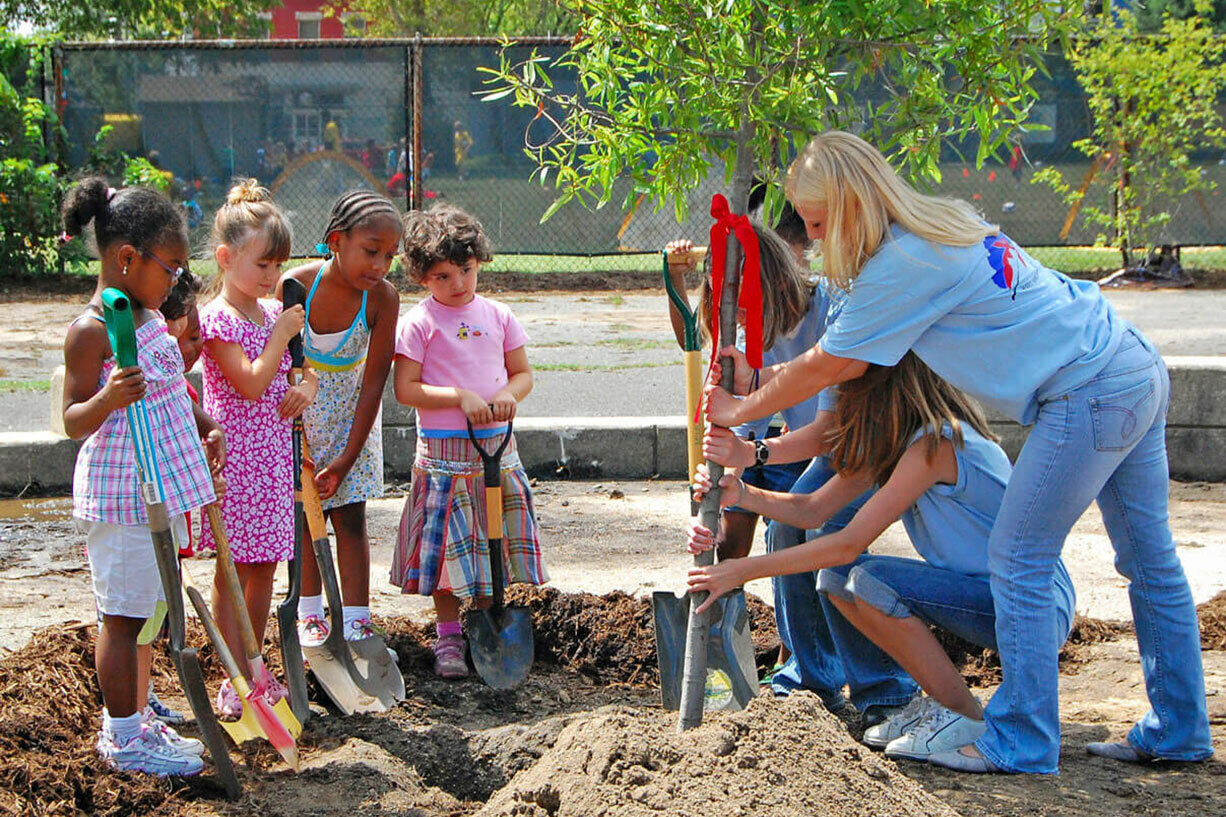
The Center City Public Charter School, Trinidad Campus held a ground-breaking ceremony and work day on May 18th. About 40 eighth grade students improved compacted soil with compost, planted trees, shrubs and numerous perennial plants.

These plants, many of them native, were used to create a sensory garden.  It was the first in a series of gardens and landscaping practices that will improve water quality, create habitat for wildlife and manage stormwater runoff; all goals of the RiverSmart Schools Program.

Students replace grass with rain gardens that help clean the bay.

Students replace grass with rain gardens that help clean the bay.

Eleven raised beds were also built and filled with soil to make an edible garden that will encourage healthy eating. This learning lab will provide outdoor seating where students will learn how their gardening efforts make a difference for the Anacostia watershed and the Chesapeake Bay. Additional gardens include a bird and butterfly garden, an upland forest and a rain garden.

This $120,000 project is a private-public partnership that includes the District Department of the Environment, FedEx, National Fish & Wildlife Foundation and Center City Public Charter School.

For additional information about RiverSmart Schools see Green DC or call Gilda Allen at 202-535-2239.

Gilda Allen is an Environmental Program Specialist at the District Department of the Environment.
Older Posts »