Horn Point Laboratory Lecture Series: Bay 101

February 28th, 2011 by Sarah

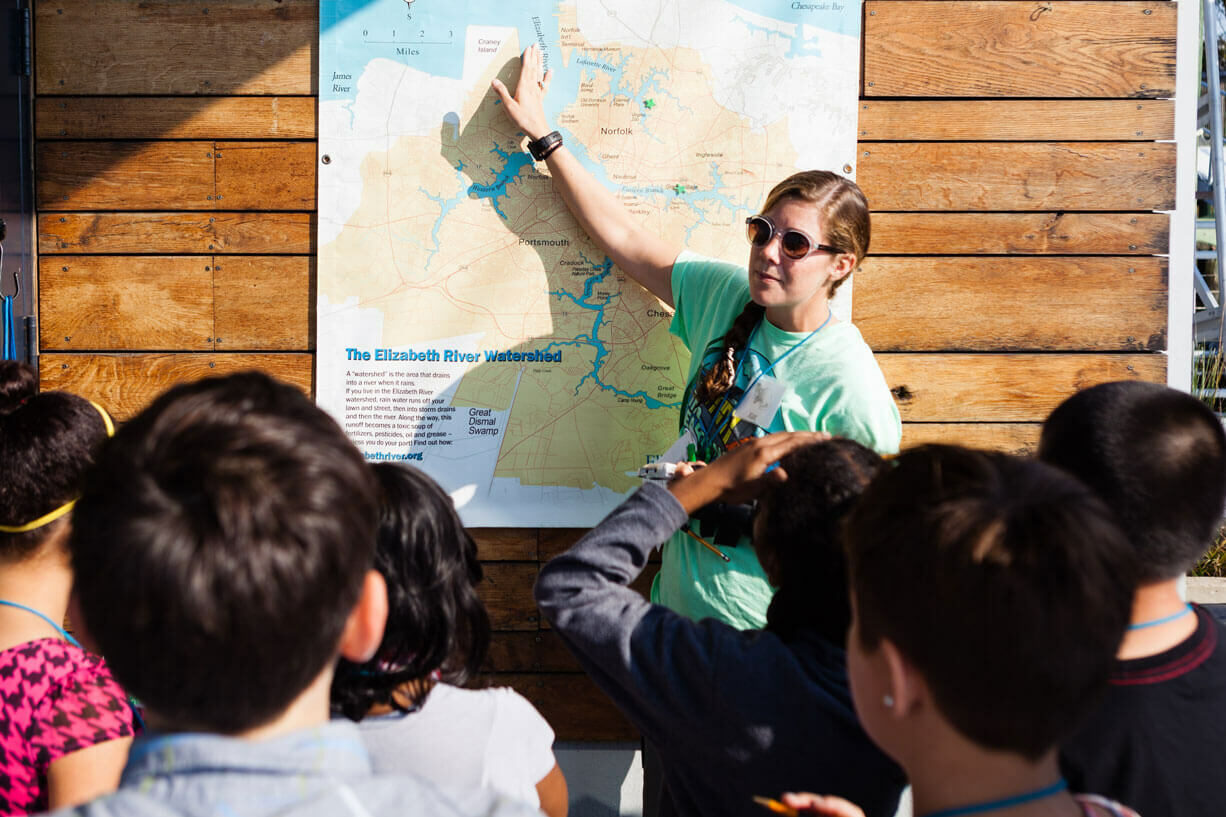
You can arrange for a tour of the Horn Point Laboratory facilities by contacting tours@hpl.umces.edu. Photo courtesy of Horn Point Laboratory.

Horn Point Laboratory will be offering a lecture series for anyone interested in learning more about current science research and the Chesapeake Bay.  Seven free presentations, addressing topics from Estuaries to Oysters, will be offered on consecutive Thursdays from mid March to late April.  Sessions will be held from 3:30 PM – 4:30 PM at the Horn Point Aquaculture and Restoration Ecology Laboratory (AREL) Lecture Hall.  Life in the Chesapeake Bay by Alice and Robert Lippson has been suggested as a text book for outside reading during the series.

Mike Roman, the Horn Point Laboratory Director, will launch BAY 101 lecture series on March 17. Photo courtesy of Horn Point Laboratory.

This is an excellent opportunity for students, teachers, and members of the local community to interact with Horn Point scientists. Getting up-to-date information on the Chesapeake Bay is a great way for teachers to start planning Bay-related lessons for their own classes!  The following topics will be covered in the Bay 101: Science of the Chesapeake for Non-Scientists lecture series: 

  • March 17: “Research and Education Programs at the Horn Point Laboratory” –  Mike Roman, Laboratory Director
  • March 24: “History of Land Use and Water Quality in the Choptank Basin” – Tom Fisher
  • March 31: “Seagrasses: What Are They and Why Should I Care?” – Laura Murray
  • April 7: “Why Do We Need More Oysters In Chesapeake Bay?” – Roger Newell
  • April 14: “Sea Level Rise and Marsh Loss in the Blackwater Refuge” – Court Stevenson
  • April 21:  “Oyster Restoration and the Horn Point Hatchery” – Don ‘Mutt’ Meritt
  • April 28: “How an Estuary Works” – Bill Boicourt

To register for the lecture series or an individual lecture, please contact Linda Starling, the Volunteer Coordinator at Horn Point Laboratory.  Linda can be reached at 410-221-8381 or 301-802-1587 or starling@umces.edu or by mail Linda Starling, PO Box 775, 2020 Horns Pt. Rd, Cambridge, MD 21613.

Sarah Brzezinski works for the Chesapeake Research Consortium as the Chesapeake Bay Program's Fostering Stewardship and Education Workgroup Team Staffer. She also serves as the content manager of Bay Backpack.

The 2011 MAEOE Conference: Educating for Sustainability

February 21st, 2011 by Sarah

Participants in the “Building Oyster Reef Balls as Habitat in the Chesapeake Bay” session at MAEOE's 2011 Conference actually built an Oyster Reef Ball! Photo courtesy of Sandy August.

This past weekend, I attended the Maryland Association for Environmental and Outdoor Education (MAEOE) Conference to promote Bay Backpack.  The conference was not only a great chance to encourage teachers to use the Bay Backpack website, but a great learning opportunity for me.

Conferences that bring environmental educators together are a great opportunity to learn something new.  With Friday sessions describing how to build and teach about Oyster Reef Balls, Schoolyard Habitats, Rain Gardens, and more, it was impossible not to come away excited about all of the ways to incorporate environmental education into a classroom setting.  Saturday sessions truly had something for everyone.  They addressed everything from Natural Play Spaces and Things that Go “Ribbit” in the Night (Amphibian Call Identification) to Your School and the Chesapeake Bay Executive Order and the Maryland No Child Left Inside and Children in Nature movements.

MAEOE will be posting many of the power points that were presented on their website, so if you would like to learn more about one of the topics that was discussed at the conference, but were unable to attend, be sure to keep checking their website for more information.

Networking is also a key aspect of this type of conference.  I know I met a lot of very nice people who are implementing some very innovative programs in their classrooms.  Making connections, sharing ideas, and learning new things are all an important part of the conference experience.

Next year’s MAEOE Conference will be held February 9 -12, 2012 at the Clarion Resort Fontainebleau in Ocean City, Maryland.  I hope to see you there, and in between you may want to check out some of these conferences for some great environmental education networking:

Filed under: News
Tags: , ,
Sarah Brzezinski works for the Chesapeake Research Consortium as the Chesapeake Bay Program's Fostering Stewardship and Education Workgroup Team Staffer. She also serves as the content manager of Bay Backpack.

National Environmental Education Week Celebrates Ocean Connections

February 14th, 2011 by Sarah Kozicki

Celebrate "Ocean Connections" as part of National Environmental Education Week, April 10-16, 2011!

Join teachers and students in exploring our Ocean Connections as part of National Environmental Education Week, April 10-16, 2011!

We might have divided it up and given the different areas different names, but there really is only one ocean. And it is the dominant feature of our planet. No matter how far we live from the coast, we are all connected to the ocean, sometimes in nearly invisible ways. For those in the Chesapeake Watershed, this connection is very strong.  In Maryland, Virginia, Pennsylvania, Virginia, West Virginia, New York, and the District of Columbia, we live a 64,299 square miles drainage basin that flows into the largest estuary in the United States of America: the Chesapeake Bay! 

From the vast network of streams and rivers that make up the major watersheds on Earth (all of which, including the Chesapeake Bay, drain into the ocean) to the ingredients in products we use every day, there is no escaping our dependence on the ocean. The ocean supplies us with food and medicine, cycles our water, generates most of the oxygen we breathe and balances our climate. Recognizing the vital importance of the ocean to all life on Earth, National Environmental Education Week’s 2011 theme is Ocean Connections.

National Environmental Education Week (EE Week) is the nation’s largest environmental education event held each year the week before Earth Day – this year, April 10-16. EE Week inspires environmental learning and stewardship among young people by connecting educators with environmental resources to promote K-12 students’ understanding of the environment. The goal of EE Week is to assist educators in incorporating more high-quality environmental education across the curriculum. In 2010, over 2,000 schools and organizations across the country organized EE Week events. Collectively these organizations reached millions of students with environmentally themed lessons and activities. 

This year, EE Week will celebrate the ocean by offering resources and curricula for teaching about the ocean and oil spills, facts about our ocean connections in English and Spanish, online Ocean Bee quizzes for students (created in partnership with National Ocean Sciences Bowl) and a series of educator webinars. The first Educator Webinar: Teaching about the Gulf Oil Spill will be held Feb. 23, 2011 at 7 p.m. EST. Register for EE Week to participate.

Registration takes only seconds but has many benefits. Registered EE Week participants receive grade-appropriate toolkits for each school day during EE Week, with outstanding lessons and activities on prevalent ocean subtopics created in partnership with Centers for Ocean Sciences Education Excellence.

Learn more about EE Week by visiting  EEWeek.org and register your school or organization to participate and join a national network of educators dedicated to increasing the environmental literacy of students.

Do you have a successful environmental education project to tell us about? We’d love to hear about it. Contact EEWeek@neefusa.org and info@baybackpack.com to share your story.

Sarah Kozicki is an Education Program Coordinator for National Environmental Education Week.

Greening Green Valley ES: Using a Rain Garden to Manage Runoff

February 7th, 2011 by Aimee

Students pose in the newly planted rain garden.

This is the site where the Green Valley Rain Garden was installed before construction began.

Heavy equipment was used to build the Green Valley Rain Garden, but many are built on a smaller scale!

Students helped construct the rain garden by planting plants.

The completed rain garden will help manage runoff from the school's paved surfaces.

Students and teachers unveil a new educational sign.

For years, Green Valley Elementary School teachers in Frederick County, Md. were forced to park in a muddy puddle after every storm. Stormwater would rush down from an upslope dirt ball field and combine with water washing off buildings and blacktop to collect in the lowest corner of the lot. This puddle was not only a nuisance, but it highlighted the need to better manage stormwater runoff and erosion at the school.

Stormwater runoff is one of the greatest causes of stream and water quality degradation in our region. After every storm event, rain water washes off impervious surfaces such as parking lots, sidewalks and lawns and rushes into our local rivers and streams. This pollutant-laden runoff contains pesticides, fertilizers, toxic chemicals, sediments and more, wreaking havoc on water quality and wildlife habitat. Thankfully, through simple measures taken by regular citizens, it is possible to slow and absorb polluted water before it reaches our streams. Converting lawn areas to natural cover, planting trees, collecting water in rain barrels or installing rain gardens are just a few of the many steps schools can take to help improve water quality.

Green Valley Rain Garden Project

Green Valley Elementary School wanted to find an environmentally healthy way to correct their stormwater problem. They teamed up with the Potomac Conservancy, who secured a grant from the Chesapeake Bay Trust to carry out a plan that would prevent the muddy puddle from forming in the parking lot while creating an important educational opportunity for their students. The plan included three elements:

  • The eroding ball field, which once funneled stormwater straight down to the parking lot, was re-graded to redirect runoff into the surrounding woodlands where it could be absorbed naturally;
  • Eroding slopes were terraced and a grassy ‘swale’ was installed to direct excess stormwater away from the parking area; and
  • Stormwater was ultimately funneled into a 1,100 square foot rain garden that was constructed in front of the school.

Rain gardens are specially designed gardens that capture stormwater and use it to nourish a beautiful community of native trees, shrubs and wildflowers. They also make great hands-on learning opportunities for students. Green Valley’s ‘Earthology’ Club, a group of more than 30 ambitious 4th and 5th graders, proudly adopted the garden and have planted more than 150 native plants. They will continue to get their hands dirty as they weed, water and mulch the garden to ensure that the young plants thrive.

Perhaps more importantly, the club is now spreading its new environmental expertise by educating other students at Green Valley on the value of rain gardens. The students will be providing an all-school presentation and they recently installed a colorful interpretive sign in front of the garden. Because the garden is located directly in front of the school entrance, all visitors to the school will see it and the signage, impacting thousands of current and future students, teachers, parents and other visitors.

Creating Your Own Rain Garden

Due to the complex stormwater problems at the school, the Green Valley project was more ambitious than many schoolyard rain garden projects need to be. Heavy equipment was used to re-grade the slopes and excavate the garden. Thankfully, most rain garden projects are much smaller and can be done more simply using basic tools like shovels, garden tillers and volunteers! You will want to ensure that your garden is placed where it can adequately capture runoff (e.g. not on top of a hill or in the wettest part of your yard) and is of sufficient size to absorb the volume of stormwater going into it. There are lots of good resources that will take you through the planning, construction and planting steps to help you create a functional and beautiful garden for your school.  Try the following two resources to start:

But most importantly, have fun!

Aimee Weldon is the Senior Director of Restoration and Lands for the Potomac Conservancy in Silver Spring, Md.