Amazing Oysters Pop-Up Reef Lesson

July 23rd, 2010 by Krissy

Using their artistic and creative skills your students can make a 3-D oyster reef just like this one.

Amazing Oysters will show elementary students how to build a 3-D pop-up oyster reef.

Oysters are truly amazing creatures.  One mature oyster can filter up to 60 gallons of water a day and oyster reefs provide vital habitat for hundreds of bay critters.

For the same amount of space, oyster reefs can have 50 times the surface area of a flat bottom. These reefs build up, just like coral reefs, to provide nooks and crannies for worms, snails, sea squirts, sponges, small crabs, fish and even baby oysters to live in.

So the oyster reef ecosystem makes the perfect local subject to teach your students about topics like biodiversity, food webs, adaptations and predator-prey relationships.

A great starting point to study oyster reefs is to use the Amazing Oysters educational activity.  In this lesson, your students will construct their very own miniature ecosystem reef.

They will learn about the critters that make the reef their home and why reefs are such a vital habitat.  Students will also discover the threats to oyster reefs including disease (MSX and Dermo), pollution and over harvesting (waterman used to call oysters Chesapeake Gold).

To complete this activity you will need the following materials:
- Copies of the reef diagram
- Construction paper
- Scissors
- Pencils or pens
- Glue
- Crayons, markers or colored pencils
- Rulers

Get started teaching about the Amazing Oyster by downloading a copy of Amazing Oysters (pdf) or for hard copy call (804) 698-4320 or e-mail Virginia.Witmer@deq.virginia.gov.

Once you complete this activity with your class let us know how it went or how you would improve the lesson by leaving a comment below.

Additional Resources
Oyster Teaching Resources – Bay Backpack
Oyster Field Studies – Bay Backpack

Krissy Hopkins is a former Chesapeake Bay Program Staffer and is currently pursuing her PhD in geology at the University of Pittsburgh.

Shoot and Share your Outdoor Moments

July 19th, 2010 by Cathy

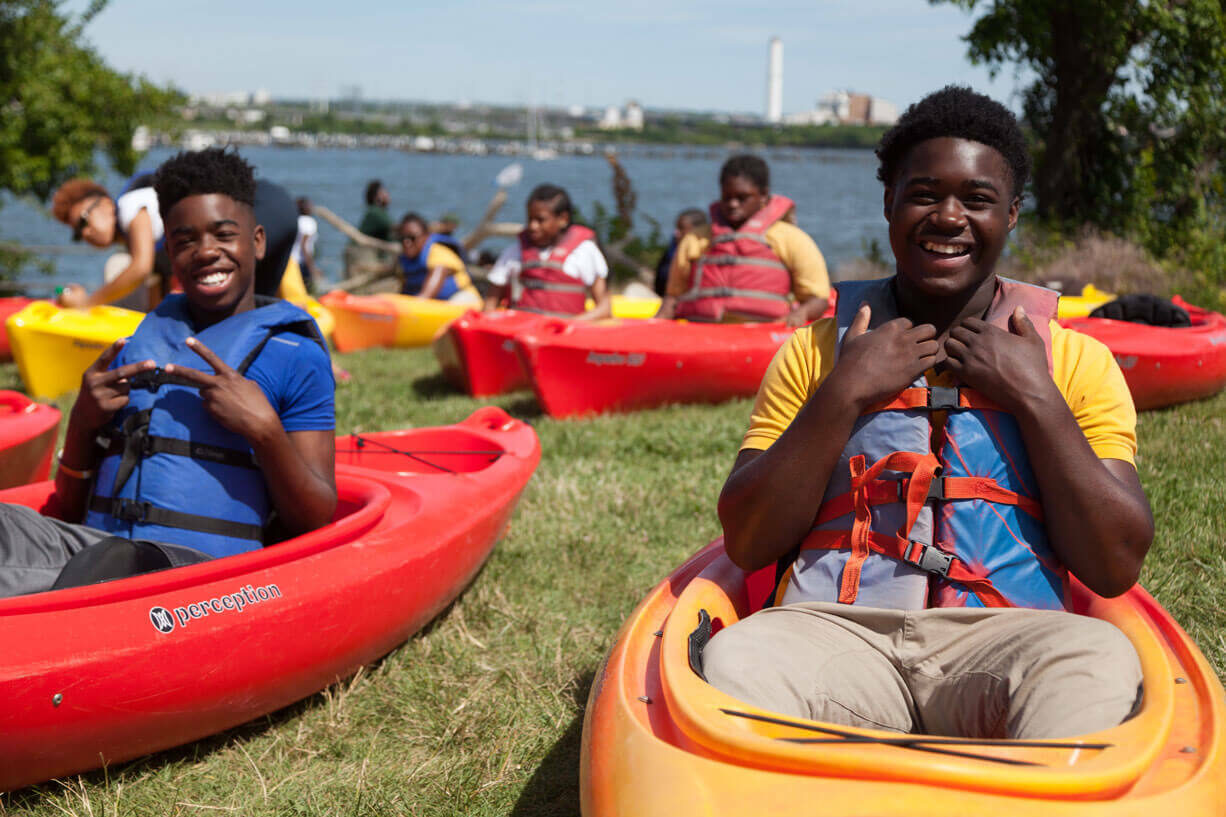
One of the images added to a group of Interns kayaking along the coastline.

The U.S. Fish & Wildlife Service is encouraging everyone to get out into nature and see some wildlife this summer with their Let’s Go Outside Campaign.  You can find nature in your backyard, at a local park or on a nearby national wildlife refuge.

Getting outside is a great way to create memories to last a lifetime.  More likely than not you will shoot pictures of these moments, so now you can share them online through Fish & Wildlife’s new Flickr group, Let’s Go Outside.  All you have to do is upload images of yourself or your students outside in nature.

You can even use Flickr’s Map function to identify where your photos were taken.  Along with adding your photos, you can also tell their stories by blogging about your experience with nature or chat on the discussion board about your favorite places to go.

Lets see how many we can get added in the Chesapeake region! Get out there and shoot and share!

Filed under: News,Teaching Resources
Tags:
Cathy Rezabeck the Regional Outreach Coordinator for U.S. Fish and Wildlife Service.

Why Teach About Sea Nettles?

July 12th, 2010 by Krissy
Sea nettles can be a pesky nuisance to swimmers in the summer months when their numbers soar.

Sea nettles can be a pesky nuisance to swimmers in the summer months when their numbers soar.

NOAA's sea nettle map shows the probably you will encounter jellies based on environmental conditions.

NOAA's sea nettle map shows the probably you will encounter jellies based on environmental conditions.

Sea nettles (Chrysaora quinquecirrha) are the most abundant jellyfish living in the Chesapeake Bay and its tidal tributaries. These stinging jellies have a smooth, milky white bell that usually grows to about four inches in diameter, with 24 stinging tentacles that hang from the inside of the bell.

Why should YOU teach about sea nettles?
Sea nettles have very particular habitat requirements making them a great critter to investigate in your classroom. Your students can become scientists by examining environmental conditions to predict when and where sea nettles will be present in the Chesapeake Bay.

Sea nettles prefer water temperatures ranging from 78.8 – 86 degrees Fahrenheit and a salinity of 10-16 PSU (practical salinity units). So when conditions in the bay are within these temperature and salinity ranges you will likely encounter sea nettles.

How do YOU teach about sea nettles?
You can use real salinity and water temperature data to have your students predict if these stinging jellies will be present at a certain location. NOAA’s CBIBs Buoys provide a database of salinity and water temperature readings at eight locations throughout the Chesapeake Bay.  Have your  students go online and write down the salinity and temperate at each of these locations.  Than have them see if the environmental conditions at each location are within the range that sea nettles prefer, 78.8 – 86 degrees Fahrenheit and a salinity of 10-16 PSU.

As an extension you can also use NOAA’s sea nettle presence probability map to compare your students’ results with a real scientific model.  Have students find the locations of their data points on NOAA’s probability map and determine if results suggest the same conclusions about the presence of sea nettles.  If differences exist, have students suggest some reasons for these differing results.

Additional Resources
The Stinging Sea Lesson Plan (Grades 9-12) – NOAA Ocean Service

Krissy Hopkins is a former Chesapeake Bay Program Staffer and is currently pursuing her PhD in geology at the University of Pittsburgh.

Bay Plates for Bay Education

July 5th, 2010 by Kacey
Ever wonder what these license plates are for?  They fund Chesapeake Bay Trust grants!

Ever wonder what these license plates are for? They fund Chesapeake Bay Trust grants!

The recovery of the Chesapeake Bay – and the future health of our environment, economy, and communities – depends on an environmentally literate and engaged citizenry. Through its environmental education programs and partnerships, the Chesapeake Bay Trust seeks to build a K-12 educational system in Maryland and the region that provides all students with the knowledge, intellectual skills, attitudes, experiences and motivation to become better stewards of the environment, their local rivers and streams, and the Chesapeake Bay.

The Chesapeake Bay Trust awards environmental education grants through two grant programs: The Mini Grant Program and the Environmental Education Grant Program.

The Mini Grant Program awards up to $5,000 to support activities at schools and non-profit organizations that help promote awareness of and participation in the restoration and protection of the Chesapeake Bay and its tributary rivers and streams. The Mini Grant Program is supported by a partnership with the National Oceanic and Atmospheric Association Bay Watershed Education and Training Program. Applications for this program must be completed by downloading the RFP which can be found on the Trust’s forms page and submitted to:

The Chesapeake Bay Trust
Attn: Mini Grant Program
60 West Street, Suite 405
Annapolis, Maryland 21401

The Environmental Education Grant Program awards funds to enhance Bay education programs and build green schoolyard projects that serve as models for schools across the state. Applicants can request up to $20,000 per project/program. This grant program is currently closed. We will announce the next round of funding to support this project approximately 3 months prior to the deadline, please continue to check our website for more information! Applications for this program must be completed online.

Additional Resources
Bay Backpack Funding Section

Filed under: Funding
Tags:
Kacey Wetzel is a Program Associate at the Chesapeake Bay Trust.

North Branch School Releases its Catch

July 1st, 2010 by Kris
Students measure fingerlings as part of the observation and documentation of the growth and changes in the trout.

Students measure fingerlings as part of the observation and documentation of the growth and changes in the trout.

  Trout in the chilled tank.  The North Branch students placed the eggs in the tank in October 2009 and cared for and studied them until their release in late April 2010.  The chilling unit was purchased through a grant from the Dominion.

North Branch students placed the eggs in the chill tank in October 2009 and cared for and studied them until their release in late April 2010. The chilling unit was purchased through a grant from the Dominion.

Two North Branch students released some of their 118 trout into the the South Fork of the Piney River.

Two North Branch students released some of their 118 trout into the the South Fork of the Piney River.

Located in Virginia just south of Afton Mountain on the eastern slope of the Blue Ridge, the North Branch School considers experiential education a major part of its guiding philosophy.

One of the school’s current endeavors is providing a Meaningful Watershed Educational Experience (MWEE) for students in grades 5-8.  To accomplish this goal they selected the Trout in the Classroom Program as their focus.

During the school year, 40 fifth through eighth graders were actively involved in all aspects of raising the trout, from assembling the tank last fall, to the day of the release in South Fork of the Piney River (part of the James River Watershed) this past April.

The year long study was launched with students examining the geography of the local watershed.  They learned to read topographic maps by tracing the major waterways in Virginia.

Then they studied water quality parameters by monitoring both their classroom trout tank and a local stream in the field by using the Virginia Save Our Streams protocol.

North Branch’s remaining 70 kindergarten through fourth grade students also participated in the project though regularly visits to the trout tank to sketch the trout in various stages of the life cycle.  Younger students conducted demonstrations and experiments and record data with the older students.

It is science teacher Maggie Buchanan’s hope that the MWEE project will increase the students’ understanding of what it takes to keep the local watershed healthy and thriving. Support for the project was provided by Dominion Power and several local natural resource agencies.

Additional Resources:
Trout in the Classroom – Trout Unlimited
North Branch School Website
Fish Related Teaching Resources – Bay Backpack

Kris Jarvis works at the Virginia Department of Environmental Quality’s Office of Environmental Education.