Better Than Disneyland!

August 1st, 2010 by Fran

Fran swimming with the "gentle giant" whale sharks at the Georgia Aquarium.

Baiting crab pots with the Chesapeake Bay Foundation on the James River.

For me personally, this has been a “magical” summer. It hasn’t been so much about learning as about living.

My summer “vacation” began two days after school let out. I participated in a three day technology conference offered by the Math, Science Information Center in Richmond, Virginia. Each day mini classes were offered that provided teachers with hands on activities to encourage kids (of all ages) to explore a variety of math and science concepts, from nanotechnology to raising trout as a classroom project.

The conference ended on Friday but Sunday was the day I waited for with breathless anticipation and wonder.   Sunday was the day I visited the Georgia Aquarium and I got to swim with whale sharks – “Gentle Giants”, measuring over 41 feet and weighing up to 26,000 tons.

It was inspirational and totally exhilarating. I can’t help getting psyched and excited every time I remember the experience.  What I also took away from the Georgia Aquarium was a passion. The passion passed on to me by everyone I met there who cared for and worked with their sea world family.

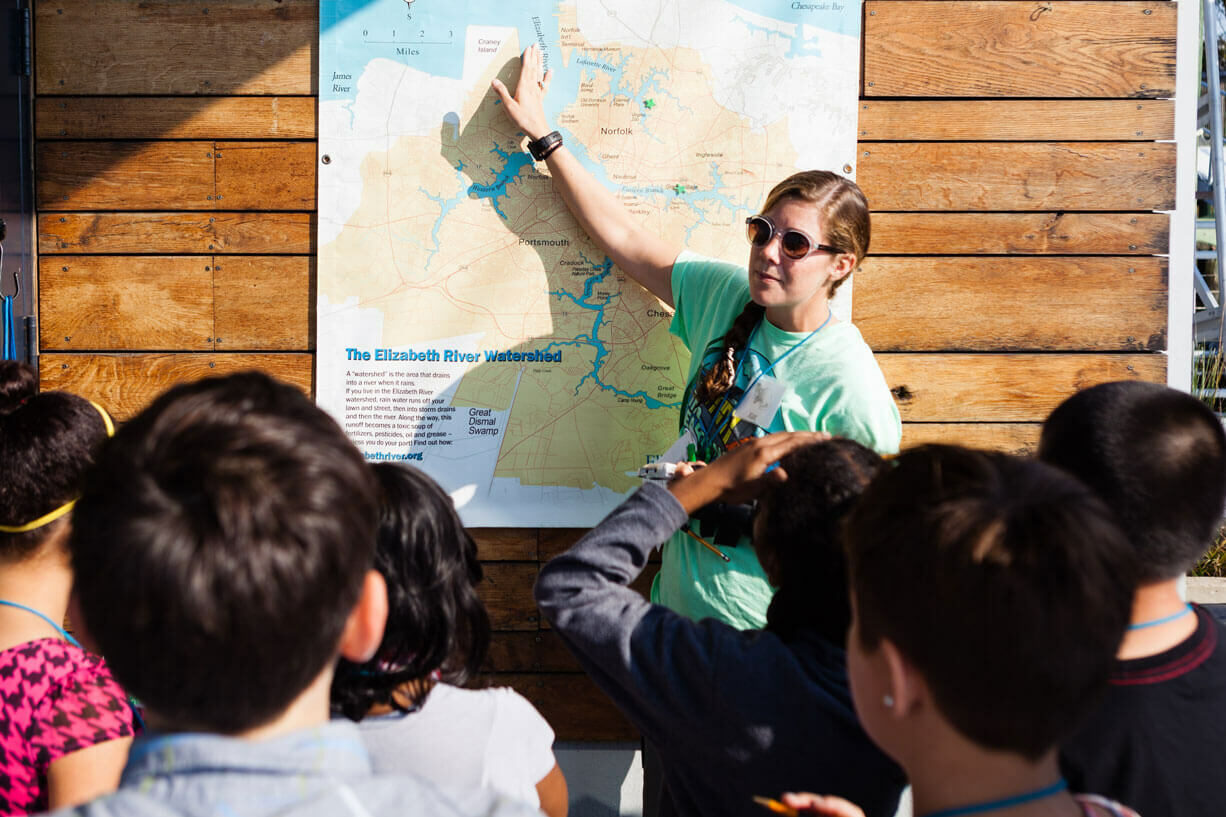
I doubted that my next adventure could “measure up”, but after three days of participating in the Chesapeake Bay Foundation’s, outdoor field course, entitled “Chesapeake Bay Classroom” I once more experienced that strong sense of dedication, caring and “passion”. It was obvious how each presenter felt about the Chesapeake Bay- the wildlife, the land, its past, present and future.

There were Chuck’s stories about the Atlantic Sturgeon coming back; Mike’s Mussels and the efforts ongoing to bring back native species to Virginia, as well as updates on the shad and herring populations; baiting crab pots with Ken on the James River and Cathy’s Prothonotary Warbler project that had all of us making birdhouses and excited about getting our students involved in a global effort to help this particularly beautiful little yellow bird.

Take a good look at the world around you – the people, the geography, the diversity of life beneath the sea and in the air – there is so much “magic”! And you know what? It’s even better than Disneyland!

Think you might be interested in Chesapeake Classrooms trainings? Check out this quick three and a half minute video.


Fran Glusiec is a special education teacher at Lee Davis High School in Mechanicsville, Virginia.

Find Professional Development this Summer

June 14th, 2010 by Krissy
Through hands-on fieldwork you gain the confidence to teach about the environment and even handle the pinches on a blue crab.

Through hands-on fieldwork you gain the confidence to teach about the environment and even handle the pinchers on a blue crab.

With the school year winding down to a close it’s time to start thinking about opportunities for professional development this summer.  There is no better way to boost your confidence for teaching about the environment than attending a workshop or training.  So get those continuing education credits while learn about our bay! Check out these opportunities this summer.

NOAA’s Environmental Science Training Center Workshops
NOAA posted its summer schedule of trainings offered at the Environmental Science Training Center on the Eastern Shore. The Center offers half-day and multi-day workshops on a variety of topics from phytoplankton monitoring to water quality testing to collecting data with Autonomous Underwater Vehicles (AUVs).  Check out the schedule and register online or email cbtraining@noaa.gov for information.

Virginia Chesapeake Bay Academies
The Virginia Resource-Use Education Council is offering four week-long Chesapeake Bay Academies this Summer. The Academies are a standard-based, learning experiences for middle and high school science teachers.  Attendees will receive training, field experiences and hands-on resources that emphasize watershed issues and the Chesapeake Bay. Upon completion of the Academy you will have the confidence to integrate meaningful field investigations into your classroom instruction.  To find an Academy near your visit the online schedule or email Paula.Klonowski@doe.virginia.gov for more information.

Chesapeake Bay Foundation Summer Immersion Courses
Every summer (June-August) the Chesapeake Bay Foundation offers in-depth FIVE day immersion courses. These courses equip you with the tools, knowledge and confidence to teach about your local environment.  Through hand-on activities you will explore the connections between the land and water in your watershed.  You will use scientific instruments to  determine how environmentally friendly your schoolyard is and the health of your local stream. All participants of these courses return to their schools and communities with the knowledge and confidence to complete a successful restoration project in your neighborhood.  So immerse yourself by registering online or emailing chesapeakeclassrooms@cbf.org for more information.

If you can’t find a professional development workshop near you contact your local community college, university, nature center or watershed organization.

Additional Resources
Professional Development Calendar – Bay Backpack
Pennsylvania Teacher Workshops – Pennsylvania Center for Environmental Education

Filed under: Training
Krissy Hopkins is part of the Chesapeake Bay Program's Fostering Stewardship Team and Education Workgroup.

Summer Institute Leaves a Lasting Impression

May 12th, 2010 by Christa
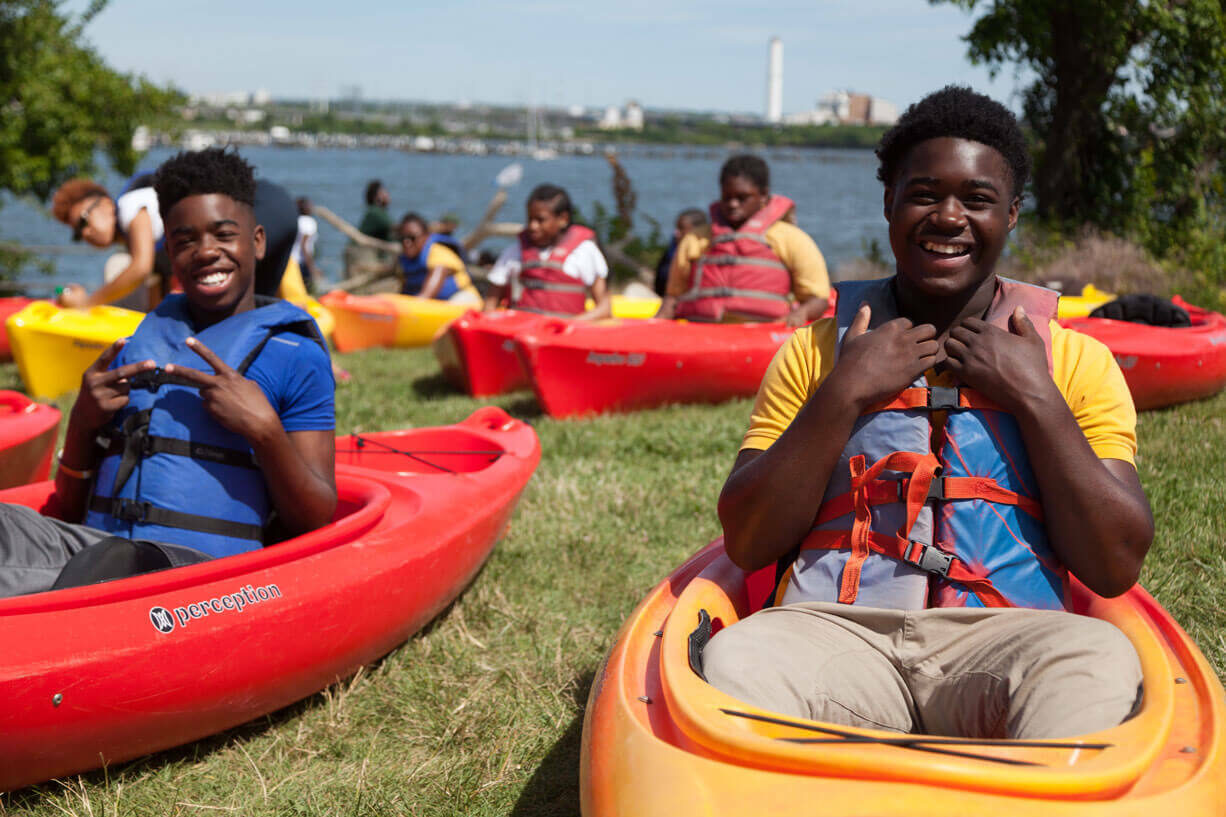
Institute participants explore the shoreline by canoe, observing the biodiversity that can be found on the Potomac River.

Institute participants explore the shoreline by canoe, observing the biodiversity that can be found on the Potomac River.

In 2006, I attended one of Hard Bargain Farm’s Environmental Science Summer Teacher Institutes. I spent a week of my summer learning about watersheds, waste management, erosion and runoff, and biodiversity. Everything we did was hands-on. Everything we did was fun. And everything we did was informative. The institute not only taught me a lot of environmental science content, it also provided me and others in attendance with extra momentum to be better environmental stewards.

Perhaps my favorite activity that we did (I have replicated it many times over with my own students) is Who Polluted the Potomac? Participants each receive a small vial with a label on it. As a story is read about the Potomac River, different participants’ labels are called to come up to the front. We each then emptied the contents of our vials into what began as crystal clear water.

Participants will learn how to test water quality – some teachers really get into it!

Participants will learn how to test water quality – some teachers really get into it!

This story is quite impactful as we learn that we are ALL responsible for the river’s pollution, and as such, there are things we can all do to help prevent the pollution in the first place! I left the institute feeling inspired and rejuvenated to bring back to my classroom not only the content of the lessons we were taught but also the pedagogy of using hands-on, inquiry-based lessons and activities with students.

But I took it a step further. I decided to focus on environmental education for my master’s degree. I graduated with the degree almost two years ago, and am now working at Hard Bargain Farm as an educator and the outreach coordinator. I love what I do because I get to teach kids and adults about the environment. And this Institute inspired me to take my career in this direction. For most people, they stay in the classroom and incorporate environmental lessons learned during the Institute and included in our curriculum binder into their pacing guides and science curricula at school.

Our institutes are now 9 days long, and this summer it will run from July 12-22. Because of grant funding we have been able to secure through NOAA BWET and the Chesapeake Bay Trust, the Institute is offered FREE of charge – in fact, participants receive a small stipend! I encourage you to come to the institute, learn about the environment, learn how to teach about the environment, and be inspired to make a positive change in our communities.

You can find more information along with registration forms on our website.

Filed under: Training
Tags: ,
Christa Haverly is the Outreach Coordinator for Alice Ferguson Foundation.

School Spotlight: It’s In The Bag

April 26th, 2010 by Claire
Cedar Grove's Discovery Bags

Cedar Grove gave a Discovery Bag to each classroom.

The teachers at Cedar Grove Elementary School (Montgomery County, MD) have added a new bag of tricks to support the Maryland No Child Left Inside Coalition. Members of our school’s science committee created ‘Discovery Bags’ for each classroom. These bags contain tools to encourage outdoor discovery, such as trowels, magnifiers, collection holders, critter identifiers, and journaling materials.

Discover Bags contain trowels, magnifiers, collection holders, critter identifiers, and journaling materials.

Discover Bags contain trowels, magnifiers, collection holders, critter identifiers, and journaling materials.

The bags alone are a testament to our school’s commitment to encourage the whole community to embrace a greener lifestyle. A school-wide Science Lab logo competition was held early in the school year with the winning student-design printed on reusable grocery bags. The bags are currently being sold as a fund raiser for lab supplies. Our art teacher trimmed a set of these reusable bags for the classroom ‘Discovery Bags’ with room numbers and hand painted embellishments.

Our Principal, Lee Derby, encourages the development of environmental literacy by giving his full support of using the outdoors as a classroom. The ‘Discovery Bags’ make it easy to take advantage of outdoor experiences. Some teachers hang their bag on the knob of the classroom door. The message is: be ready for any opportunity to learn!

Claire participated in Teachable Science Workshops offered by the Audubon Naturalist Society where Instructor Lara Rosa shared the idea of creating ‘Discovery Bags’.

Filed under: School Spotlight,Training
Tags:
Claire Gardner is a 2nd grade teacher at Cedar Grove Elementary School in Montgomery County, Maryland.

Mentoring Transforms Students into Scientists

April 23rd, 2010 by LeeAnn
To record monthly mortality and growth, students retrieve one of their experimental oyster cages at the Cooperative Oxford Lab pier.

To record monthly mortality and growth, students retrieve one of their experimental oyster cages at the Cooperative Oxford Lab pier.

The Partnership of Scientists and Students for the Environment (POSSE) is a program which matches scientist mentors to high school students, and promotes and supports community partnerships. Mentorships range from interviews, emails, and phone calls to active engagement in research, whereby students work side by side with their respective scientist mentors.

Working alongside their mentor, students are learning how the experts assess the bats and how to record data accurately.  They are also learning that bats contribute crucially to the food web, including their beneficial consumption of mosquitoes, and thus stability and health of an ecosystem.

Working alongside their mentor, students are learning how the experts assess the bats and how to record data accurately. They are also learning that bats contribute crucially to the food web, including their beneficial consumption of mosquitoes, and thus stability and health of an ecosystem.

Initiated in Fall 2008, POSSE began with 31 students and 9 scientist mentors. It has grown to include 62 students and 35 scientists on the Eastern Shore of Maryland. Projects include research on oyster growth and mortality, where students and a mentor scientist with the Department of Natural Resources, collected data their senior year in high school up through their freshman year in college. Their work is expected to be published in a professional journal.

Stranded…
Mentoring another student project with a hands-on approach, a DNR veterinarian and marine mammal stranding team biologist expose students to issues facing seals, sea turtles and cetaceans (whales and dolphins), and the role scientists play in strandings. A recent student team researched the effects of sound and blast trauma on the hearing of cetaceans, while another team is interested in the overall causes of strandings. Mentees have participated in the stranding volunteer training, observed necropsies of affected animals, and assisted in data collection.

Gone Batty…
DNR mentors are also assisting students with investigation of White-nose Syndrome in bats, a condition associated with the deaths of over 100,000 hibernating bats in the NE United States. Students participate in the data collection, learn proper protocol during necropsy, and use USGS distribution maps to follow the spread of this disease.

Other projects include an oyster documentary, a study of mycobacteriosis, an amphibian and reptile study, harmful algal blooms, aquaculture techniques, and horseshoe crab biomedical uses.

This year’s POSSE students will present the annual Environmental Issues: A Science Symposium at Horn Point Laboratory on Thursday May 20, 2010. The event is free and open to the public. For details, contact LeeAnn Hutchison at lhutchison@msde.state.md.us.

LeeAnn Hutchison is an Environmental Education Specialist at the Maryland State Department of Education.

Wind for Schools Program Blows into Virginia

March 22nd, 2010 by Remy
Wind for Schools manual

Wind for Schools Powering America.

Looking for a student centered learning project for your school? How about learning about wind energy by installing a wind turbine at your school? Through the new Wind for Schools Program at James Madison University schools can apply to have a small wind turbine installed on their campus as a learning tool.

Not only will your school get to have state-of-the-art technology for generating clean energy, but teachers will be trained on energy education and receive hands-on curricula and kits to use in the classroom that bring the wind turbine into the classroom through interactive and interschool wind-related research tasks. Materials from many curricula are used and samples of activities and links to full curricula can be found online.

JMU will be hosting a State Wind Symposium June 16th and 17th. As part of this Symposium there will be a National Energy Education Development (NEED) teacher workshop on wind energy and an informational session for teachers or school administrators that are interested in finding out more about this program.

If your school is interested in participating in the program or any of these upcoming events please contact Remy Luerssen at luerssrm@jmu.edu or 540-568-8768 for more information.

Additional Resources:

Remy Luerssen is the Mapping and Education Specialist with the Virginia Coastal Energy Research Consortium at James Madison University.