Greening Green Valley ES: Using a Rain Garden to Manage Runoff

February 7th, 2011 by Aimee

Students pose in the newly planted rain garden.

This is the site where the Green Valley Rain Garden was installed before construction began.

Heavy equipment was used to build the Green Valley Rain Garden, but many are built on a smaller scale!

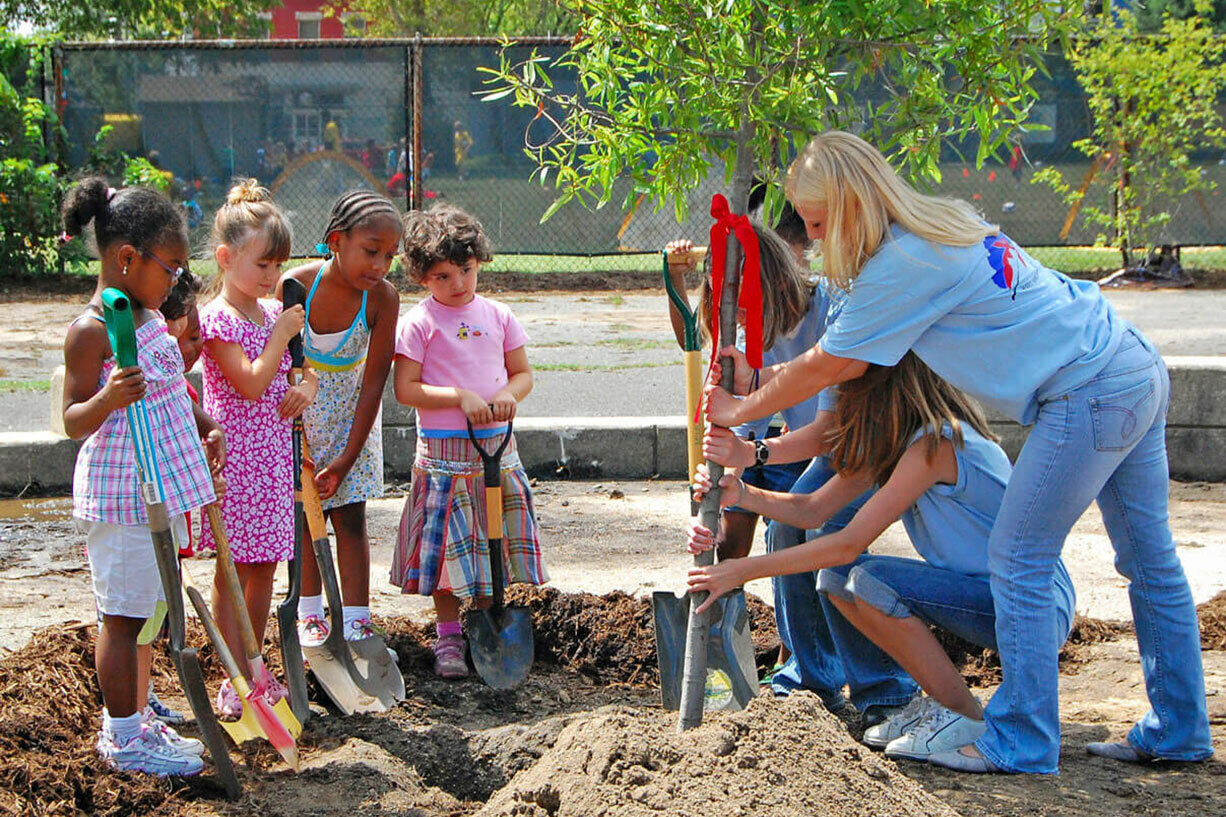
Students helped construct the rain garden by planting plants.

The completed rain garden will help manage runoff from the school's paved surfaces.

Students and teachers unveil a new educational sign.

For years, Green Valley Elementary School teachers in Frederick County, Md. were forced to park in a muddy puddle after every storm. Stormwater would rush down from an upslope dirt ball field and combine with water washing off buildings and blacktop to collect in the lowest corner of the lot. This puddle was not only a nuisance, but it highlighted the need to better manage stormwater runoff and erosion at the school.

Stormwater runoff is one of the greatest causes of stream and water quality degradation in our region. After every storm event, rain water washes off impervious surfaces such as parking lots, sidewalks and lawns and rushes into our local rivers and streams. This pollutant-laden runoff contains pesticides, fertilizers, toxic chemicals, sediments and more, wreaking havoc on water quality and wildlife habitat. Thankfully, through simple measures taken by regular citizens, it is possible to slow and absorb polluted water before it reaches our streams. Converting lawn areas to natural cover, planting trees, collecting water in rain barrels or installing rain gardens are just a few of the many steps schools can take to help improve water quality.

Green Valley Rain Garden Project

Green Valley Elementary School wanted to find an environmentally healthy way to correct their stormwater problem. They teamed up with the Potomac Conservancy, who secured a grant from the Chesapeake Bay Trust to carry out a plan that would prevent the muddy puddle from forming in the parking lot while creating an important educational opportunity for their students. The plan included three elements:

  • The eroding ball field, which once funneled stormwater straight down to the parking lot, was re-graded to redirect runoff into the surrounding woodlands where it could be absorbed naturally;
  • Eroding slopes were terraced and a grassy ‘swale’ was installed to direct excess stormwater away from the parking area; and
  • Stormwater was ultimately funneled into a 1,100 square foot rain garden that was constructed in front of the school.

Rain gardens are specially designed gardens that capture stormwater and use it to nourish a beautiful community of native trees, shrubs and wildflowers. They also make great hands-on learning opportunities for students. Green Valley’s ‘Earthology’ Club, a group of more than 30 ambitious 4th and 5th graders, proudly adopted the garden and have planted more than 150 native plants. They will continue to get their hands dirty as they weed, water and mulch the garden to ensure that the young plants thrive.

Perhaps more importantly, the club is now spreading its new environmental expertise by educating other students at Green Valley on the value of rain gardens. The students will be providing an all-school presentation and they recently installed a colorful interpretive sign in front of the garden. Because the garden is located directly in front of the school entrance, all visitors to the school will see it and the signage, impacting thousands of current and future students, teachers, parents and other visitors.

Creating Your Own Rain Garden

Due to the complex stormwater problems at the school, the Green Valley project was more ambitious than many schoolyard rain garden projects need to be. Heavy equipment was used to re-grade the slopes and excavate the garden. Thankfully, most rain garden projects are much smaller and can be done more simply using basic tools like shovels, garden tillers and volunteers! You will want to ensure that your garden is placed where it can adequately capture runoff (e.g. not on top of a hill or in the wettest part of your yard) and is of sufficient size to absorb the volume of stormwater going into it. There are lots of good resources that will take you through the planning, construction and planting steps to help you create a functional and beautiful garden for your school.  Try the following two resources to start:

But most importantly, have fun!

Aimee Weldon is the Senior Director of Restoration and Lands for the Potomac Conservancy in Silver Spring, Md.

Starting a School Garden Without All the “Stuff”

October 11th, 2010 by Roberta

Children help out at Granny's Garden School in 2008.

In celebration of D.C. School Garden Week 2010, we bring you this post from Roberta Paolo, the executive director of “Granny’s Garden School,” a community garden in Loveland, Ohio, for all of the area’s nearly 1,800 kindergarten through fourth grade students. Roberta’s experiences in Ohio can certainly be applied in the D.C. area, the rest of the Chesapeake Bay watershed and throughout the entire United States!

***

School gardens are all the rage right now.  Judging by what is going on in the Greater Cincinnati Area, where I am located, there have to be thousands of new programs being launched across the country this year.

The combination of the impact from the book “Last Child in the Woods” and the resulting groundswell of concern that led to the grassroots development of the organization “Leave No Child Inside” has been compounded by the rising problem with childhood obesity. The concern about global warming has also been topped off by the establishment of a garden on the grounds of the White House, all of which has resulted in an explosion of interest in developing school garden programs.

This is both good and bad. At this time, and in the next couple of years, a lot of money will be invested in school garden programs. Most of this money will be spent to buy “stuff.” It will be used to build raised beds, buy rain barrels, install green houses and/or hoop houses, install rain gardens, grow labs, curriculum and lesson plans and buy all kinds of “kits.”

Every day, there are more companies offering tools, garden boxes, over-priced kits and other supplies targeted to educators with school garden grant money to spend. Could you use a $70 folding fabric wheel barrel? Or how about the $29.95 Potato Planter? Many people will find a rationale to buy these largely unnecessary products using their grant money.

Very little, if any, of the millions of dollars will be spent to pay people to run the programs. When the person with the passion whose enthusiasm powered the garden initiative can no longer volunteer or moves on for whatever reason, the program will be phased out. The grounds people, who are left with the mess to clean up, will be there to say, “I told you so.”  This will make it that much more difficult to get administrators to take a chance the next time a person with a passion comes along with an idea to enrich the school experience for our children.

Starting a school garden program is the easy part and it does not have to take a lot of money. We ran our program the first year on less than $200. You do not need much “stuff” and you can get almost everything you need donated.

Starting a garden program can be as simple as digging a hole and planting a seed.  The real challenge is in sustaining it. If you are up to the challenge, it could be the most rewarding thing you ever do.

Roberta Paolo is the Executive Director of Granny's Garden School in Loveland, Ohio, serving nearly 1,800 K-4th grade students in the community.

Sowing the Seeds for an Outdoor Classroom

September 13th, 2010 by Kris
Students outline the location of their wildlife habitat using string.

Student measure the size of their wildlife garden. Photo credit: Farmwell Station

Farmwell students digging holes for the plants that make up the butterfly garden. Photo credit: Farmwell Station

The seeds for what would become Farmwell Station Middle School’s outdoor classroom were figuratively planted when life science teacher, Cynthia Walsh attended a box turtle monitoring training, sponsored by Virginia Department of Game and Inland Fisheries.

As a Master Naturist and the adviser to the Naturalist Club at her school, Ms. Walsh felt a schoolyard habitat project would provide her club members with a meaningful community experience and serve the entire student body with a space to use as an outdoor classroom.  And don’t forget the benefits of the outdoor classroom to wildlife as well.

Her overall goal was for students to learn that everyone can do something to help conserve wildlife, even in urban Loudoun County, Virginia.  With assistance from the school’s shop class and the Virginia Bluebird Society, the 25 member Naturalist Club installed a bluebird trail on school grounds, as well as phase one of their landscaping project adjacent to the 7th grade wing.

Plans are underway to complete a monarch butterfly count and collect additional field data that complements the scientific investigation strand of the standards of learning.  Phase two of the project is expected to include an ever increasing number of students, the development of a rain garden to filter runoff from the school roof and parking lot, and additional plantings and other elements for the outdoor classroom.

Additional Resources
Schoolyard Habitat Guide – Fish and Wildlife Service
Schoolyard Habitat Lesson – Bay Backpack

Kris Jarvis works at the Virginia Department of Environmental Quality’s Office of Environmental Education.

D.C. School Becomes River Smart

May 25th, 2010 by Gilda
Students provide habitat by planting native species.

Students provide habitat by planting native species.

The Center City Public Charter School, Trinidad Campus held a ground-breaking ceremony and work day on May 18th. About 40 eighth grade students improved compacted soil with compost, planted trees, shrubs and numerous perennial plants.

These plants, many of them native, were used to create a sensory garden.  It was the first in a series of gardens and landscaping practices that will improve water quality, create habitat for wildlife and manage stormwater runoff; all goals of the RiverSmart Schools Program.

Students replace grass with rain gardens that help clean the bay.

Students replace grass with rain gardens that help clean the bay.

Eleven raised beds were also built and filled with soil to make an edible garden that will encourage healthy eating. This learning lab will provide outdoor seating where students will learn how their gardening efforts make a difference for the Anacostia watershed and the Chesapeake Bay. Additional gardens include a bird and butterfly garden, an upland forest and a rain garden.

This $120,000 project is a private-public partnership that includes the District Department of the Environment, FedEx, National Fish & Wildlife Foundation and Center City Public Charter School.

For additional information about RiverSmart Schools see Green DC or call Gilda Allen at 202-535-2239.

Gilda Allen is an Environmental Program Specialist at the District Department of the Environment.

Riders in the Environment Improving Native Shorelines

May 10th, 2010 by LeeAnn
REINS participants and their mentors use horses and ponies to learn about their connection to the Chesapeake Bay.

REINS participants and their mentors use horses and ponies to learn about their connection to the Chesapeake Bay.

The Riders in the Environment Improving Native Shorelines or REINS project, serves students 7 – 21 years of age in public schools on the Eastern Shore of Maryland.  The program is funded through the Maryland DNR Aquatic Resources Education Grants Program.

The focus is to provide a Meaningful Watershed Educational Experience (MWEE) which includes equitherapy, aquatic studies, and action projects to engage developmentally disabled students in the investigation of ponds and streams connected to the Choptank River.

The project increases student knowledge of aquatic resources, identifies personal connections to water, and determines actions which are appropriate and helpful to waterways at the study site. The student action plans, which include a rain garden and native plantings, enhance the property’s natural qualities and protect the aquatic environment adjacent to the farm.

Students use basic ecological equipment and materials, enjoy eco-art projects, learn to identify wetland plants and animals at the farm, and record findings in a naturalist journal. Because they are learning through equine-assisted strategies, students also begin to comprehend the connection between horses (and other livestock) and the health of their local waterways.

Farm staff provides equitherapy to complement the aquatic studies, which are taught by educators and other trained volunteers. To accomplish this, students learn in the classroom (barn) and on the trail (by the pond and stream areas). They are responsible for keeping track of and caring for their own saddle bags, which contain their “water study kits”. Students are provided with strict adult supervision during all lessons. Service learning hours can be earned in two ways – peer mentors will earn credits for assisting their “buddies” in the lessons, and the disabled riders will earn hours for working on the action projects.

The action component of the project gives meaning to students and helps them comprehend their roles in becoming valuable stewards of the Chesapeake Bay watershed. Specifically, students work side by side with experts and peer mentors to help design and maintain a rain garden and native plantings garden. In addition, students determine ways to reduce the impact of livestock waste on their local waterways, and determine ways to reduce water pollution which may affect animal health.

For more information visit Timber Grove Farm or contact LeeAnn Hutchison at lhutchison@msde.state.md.us.

LeeAnn Hutchison is an Environmental Education Specialist at the Maryland State Department of Education.

How to Create a Schoolyard Habitat

January 17th, 2010 by Krissy

This schoolyard habitat and garden acts as an outdoor classroom for the entire school

This schoolyard habitat and garden acts as an outdoor classroom for the entire school

Creating a habitat for wildlife in your schoolyard will not only give local wildlife a safe healthy place to live, but it will provide students with an easily-accessible outdoor classroom and provide opportunities for students to observe wildlife in ways they may not have had otherwise. Habitat loss is an increasing pressure on wildlife. Whether you live in a city, in a forest, or in wide-open farmland, every little step you can take towards protecting your local environment will help. It will help the environment in the short-term, and spark a long-term interest in students, which could stay with them into adulthood.

After learning how to create and care for the habitat, students can observe various animals better than they might have been able to otherwise. Students can watch as beautiful butterflies land and enjoy their mud bath. In the spring, students can watch adult birds go to/from a bird house with small twigs, then watch as the parents start bringing food to the young. Finally, students might be able to see the fledglings take their first ventures out into the wild. Classes can also observe as plants begin to grow, flowers bloom, and insects pollinate. As the season changes from summer to fall, trees can provide a lesson in biology, while squirrels’ nut-gathering can be a behavior study.

A successful habitat for wildlife needs several things. Food, water, shelter/cover, and a place for animals to safely rear their young are all essentials. The National Wildlife Federation provides a guide on how to create a schoolyard habitat, as well as instructions on how to register your habitat with the National Wildlife Federation’s Certified Wildlife Habitat™ Program.

Resources:

Schoolyard Habitat Guide – Fish and Wildlife Service

Native Plants of the Chesapeake Guide – Fish and Wildlife Service

Krissy Hopkins is a former Chesapeake Bay Program Staffer and is currently pursuing her PhD in geology at the University of Pittsburgh.