D.C. School Becomes River Smart

May 25th, 2010 by Gilda
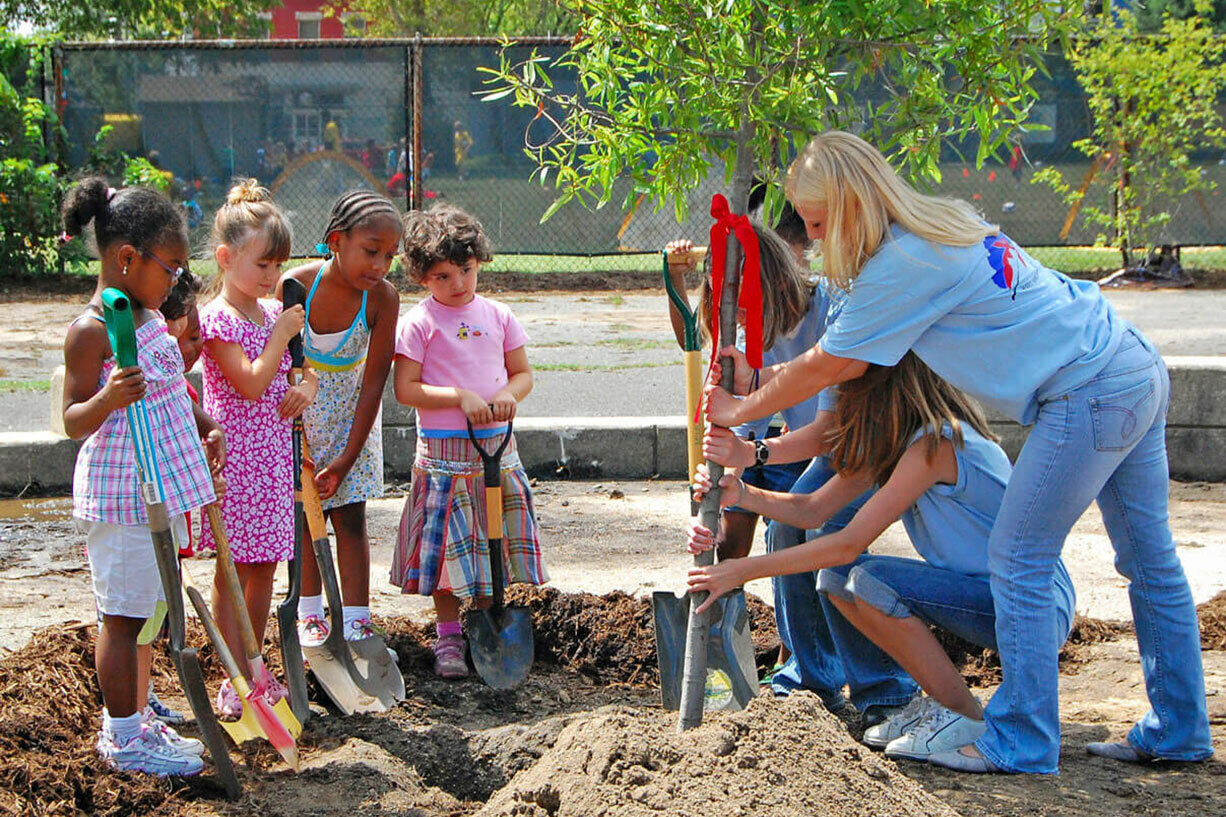
Students provide habitat by planting native species.

Students provide habitat by planting native species.

The Center City Public Charter School, Trinidad Campus held a ground-breaking ceremony and work day on May 18th. About 40 eighth grade students improved compacted soil with compost, planted trees, shrubs and numerous perennial plants.

These plants, many of them native, were used to create a sensory garden.  It was the first in a series of gardens and landscaping practices that will improve water quality, create habitat for wildlife and manage stormwater runoff; all goals of the RiverSmart Schools Program.

Students replace grass with rain gardens that help clean the bay.

Students replace grass with rain gardens that help clean the bay.

Eleven raised beds were also built and filled with soil to make an edible garden that will encourage healthy eating. This learning lab will provide outdoor seating where students will learn how their gardening efforts make a difference for the Anacostia watershed and the Chesapeake Bay. Additional gardens include a bird and butterfly garden, an upland forest and a rain garden.

This $120,000 project is a private-public partnership that includes the District Department of the Environment, FedEx, National Fish & Wildlife Foundation and Center City Public Charter School.

For additional information about RiverSmart Schools see Green DC or call Gilda Allen at 202-535-2239.

Gilda Allen is an Environmental Program Specialist at the District Department of the Environment.

From Farm to Fork

May 21st, 2010 by Krissy
Baltimore City students learn about livestock at a local farm.

Baltimore City students learn about livestock at a local farm.

Guess how far a typical food item in the U.S. travels to get from farm to fork. The answer is an astounding average of 1,500 to 2,400 miles. That’s like driving from the top of Maine to the tip of Florida.

Nearly one-quarter of the Chesapeake Bay watershed’s land area is devoted to agriculture. Farms in our area supply us with grains, eggs, meat, milk and vegetables. Imagine connecting your student’s forks to a local farm in your area!

The Farm to School Program does just that by supplying K-12 schools with local fresh, nutritional produce. Farm to School teaches students about healthy eating habits. A study shows that Farm to School cafeteria meals result in the consumption of .99 to 1.3 more servings of fruits and vegetables.

Along with healthier eating habits, students also learn about agriculture through taste tests, schools gardens, composting programs and farm tours. These experiences help students understand where food comes from and how the choices they make affect their health, local streams and rivers and the community.

Farm to School Project Ideas
- Plan nutrition education activities like a “Harvest of the Month” featuring local foods
- Host a local farmers market on school grounds
- Connect with a local farmer and take a farm tour
- Offer a local foods salad bar

The Farm to School Program is available in every state in the Chesapeake Bay watershed. Find a program in your state and reconnect our farms to our fork.

Additional Resources
- Healthy Farms, Healthy Kids Report – Community Food Security Coalition
- Farming Lesson Plans – Bay Backpack
- Growing Green Dreams – Washington Youth Garden

Filed under: Teaching Resources
Tags: ,
Krissy Hopkins is a former Chesapeake Bay Program Staffer and is currently pursuing her PhD in geology at the University of Pittsburgh.

Summer Institute Leaves a Lasting Impression

May 12th, 2010 by Christa
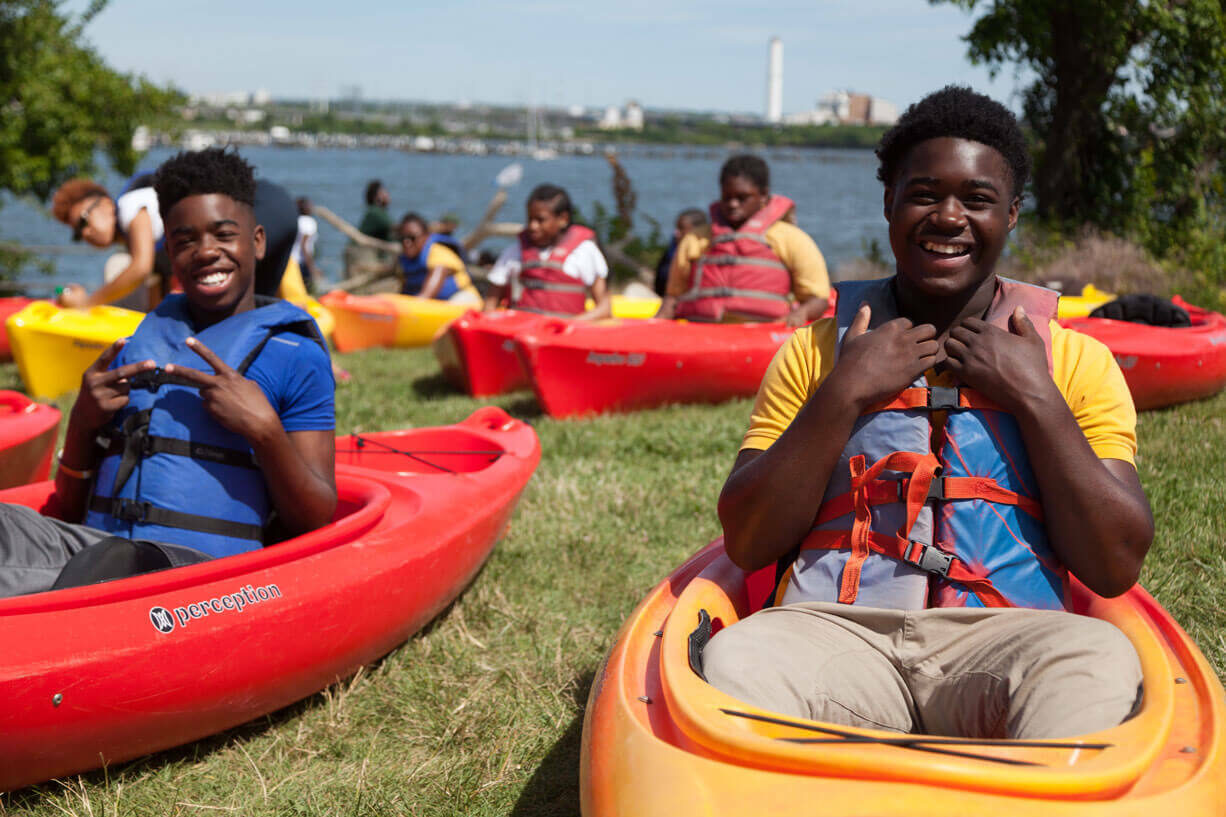
Institute participants explore the shoreline by canoe, observing the biodiversity that can be found on the Potomac River.

Institute participants explore the shoreline by canoe, observing the biodiversity that can be found on the Potomac River.

In 2006, I attended one of Hard Bargain Farm’s Environmental Science Summer Teacher Institutes. I spent a week of my summer learning about watersheds, waste management, erosion and runoff, and biodiversity. Everything we did was hands-on. Everything we did was fun. And everything we did was informative. The institute not only taught me a lot of environmental science content, it also provided me and others in attendance with extra momentum to be better environmental stewards.

Perhaps my favorite activity that we did (I have replicated it many times over with my own students) is Who Polluted the Potomac? Participants each receive a small vial with a label on it. As a story is read about the Potomac River, different participants’ labels are called to come up to the front. We each then emptied the contents of our vials into what began as crystal clear water.

Participants will learn how to test water quality – some teachers really get into it!

Participants will learn how to test water quality – some teachers really get into it!

This story is quite impactful as we learn that we are ALL responsible for the river’s pollution, and as such, there are things we can all do to help prevent the pollution in the first place! I left the institute feeling inspired and rejuvenated to bring back to my classroom not only the content of the lessons we were taught but also the pedagogy of using hands-on, inquiry-based lessons and activities with students.

But I took it a step further. I decided to focus on environmental education for my master’s degree. I graduated with the degree almost two years ago, and am now working at Hard Bargain Farm as an educator and the outreach coordinator. I love what I do because I get to teach kids and adults about the environment. And this Institute inspired me to take my career in this direction. For most people, they stay in the classroom and incorporate environmental lessons learned during the Institute and included in our curriculum binder into their pacing guides and science curricula at school.

Our institutes are now 9 days long, and this summer it will run from July 12-22. Because of grant funding we have been able to secure through NOAA BWET and the Chesapeake Bay Trust, the Institute is offered FREE of charge – in fact, participants receive a small stipend! I encourage you to come to the institute, learn about the environment, learn how to teach about the environment, and be inspired to make a positive change in our communities.

You can find more information along with registration forms on our website.

Filed under: Training
Tags: ,
Christa Haverly is the Outreach Coordinator for Alice Ferguson Foundation.

Riders in the Environment Improving Native Shorelines

May 10th, 2010 by LeeAnn
REINS participants and their mentors use horses and ponies to learn about their connection to the Chesapeake Bay.

REINS participants and their mentors use horses and ponies to learn about their connection to the Chesapeake Bay.

The Riders in the Environment Improving Native Shorelines or REINS project, serves students 7 – 21 years of age in public schools on the Eastern Shore of Maryland.  The program is funded through the Maryland DNR Aquatic Resources Education Grants Program.

The focus is to provide a Meaningful Watershed Educational Experience (MWEE) which includes equitherapy, aquatic studies, and action projects to engage developmentally disabled students in the investigation of ponds and streams connected to the Choptank River.

The project increases student knowledge of aquatic resources, identifies personal connections to water, and determines actions which are appropriate and helpful to waterways at the study site. The student action plans, which include a rain garden and native plantings, enhance the property’s natural qualities and protect the aquatic environment adjacent to the farm.

Students use basic ecological equipment and materials, enjoy eco-art projects, learn to identify wetland plants and animals at the farm, and record findings in a naturalist journal. Because they are learning through equine-assisted strategies, students also begin to comprehend the connection between horses (and other livestock) and the health of their local waterways.

Farm staff provides equitherapy to complement the aquatic studies, which are taught by educators and other trained volunteers. To accomplish this, students learn in the classroom (barn) and on the trail (by the pond and stream areas). They are responsible for keeping track of and caring for their own saddle bags, which contain their “water study kits”. Students are provided with strict adult supervision during all lessons. Service learning hours can be earned in two ways – peer mentors will earn credits for assisting their “buddies” in the lessons, and the disabled riders will earn hours for working on the action projects.

The action component of the project gives meaning to students and helps them comprehend their roles in becoming valuable stewards of the Chesapeake Bay watershed. Specifically, students work side by side with experts and peer mentors to help design and maintain a rain garden and native plantings garden. In addition, students determine ways to reduce the impact of livestock waste on their local waterways, and determine ways to reduce water pollution which may affect animal health.

For more information visit Timber Grove Farm or contact LeeAnn Hutchison at lhutchison@msde.state.md.us.

LeeAnn Hutchison is an Environmental Education Specialist at the Maryland State Department of Education.

Why Teach About Wetlands?

May 3rd, 2010 by Krissy
Can you find the great blue heron hiding in this Chesapeake wetland? Photo Source: Chesapeake Bay Program

Can you find the great blue heron hiding in this Chesapeake wetland? Photo Source: Chesapeake Bay Program

May is American Wetlands Month, a time to recognize the importance of this habitat for its ecological, economic and social health value. Take the opportunity in May to teach your students about the role of wetlands in providing habitat, clean water and reducing flooding risk.

Wetlands and open water at Blackwater National Wildlife Refuge.  Photo Source: IAN, Jane Thomas

Wetlands and open water at Blackwater National Wildlife Refuge. Photo Source: IAN, Jane Thomas

So what is a wetland?
Wetlands are transitional areas between land and water. An area is defined as a wetland if it has hydrophytes (plants adapted to living in wet soils) and hydric soils (soils that are periodically soaked or flooded).

In the Chesapeake region wetlands can be further broken down into two categories: tidal and non-tidal. Tidal wetlands are flooded with salt or brackish water when tides rise and non-tidal wetlands contain fresh water. About 86% of the wetlands in the Chesapeake Bay watershed are non-tidal.

Why should YOU teach about wetlands?
Wetlands are one of the most critical habitats for hundreds of species of fish, birds, mammals and invertebrate in the Chesapeake region.  Tidal wetlands are a winter home for waterfowl that visit the Chesapeake Bay as they migrate along the Atlantic Flyway. Wetlands are also the nurseries and spawning grounds for blue crabs, fish and shellfish that waterman and fishermen depend on for their livelihood.  Roughly 2/3 of our commercially valuable fish and most shellfish use tidal wetlands as  nursery areas.

Wetlands also improve and protect the Chesapeake Bay’s health. These saturated areas between the land and the water act as buffers by slowing the flow of pollutants into the Bay and its rivers. As polluted stormwater runs off the land and passes through wetlands, the trees and grasses in wetlands filter and absorb nutrients, suspended sediments and chemical contaminants before these pollutants can flow to nearby waterways.

Wetlands also help control erosion. Just like a sponge, wetlands soak up and hold large amounts of flood water and stormwater runoff, gradually releasing the water over time. Wetlands along the edges of streams, creeks, rivers and the Bay stabilize shorelines and protect properties from floods and waves. Because of the high ecological and economic value of wetlands its very important that we keep them wet and wild.

So how do YOU teach about wetlands?
Luckily, there are tons of lesson plans available that focus on wetlands! Here are a few of the best ones you can use in your classroom. These include hands-on investigations that get students actively engaged in learning.

Krissy Hopkins is a former Chesapeake Bay Program Staffer and is currently pursuing her PhD in geology at the University of Pittsburgh.