Why Teach About Watersheds?

February 25th, 2010 by Krissy
Map of the Chesapeake Bay Watershed. Source: National Geographic

Map of the Chesapeake Bay Watershed. Source: National Geographic

We all live in a watershed and chances are if you are on the Bay Backpack site you live in the Chesapeake Bay watershed.  The Chesapeake Bay watershed stretches across more than 64,000 square miles, encompassing parts of six states -Delaware, Maryland, New York, Pennsylvania, Virginia and West Virginia – and the entire District of Columbia.  Almost 17 million people live in the Chesapeake Bay watershed and the things those people do every day impact how clean our local waterways are.

So What is a Watershed?

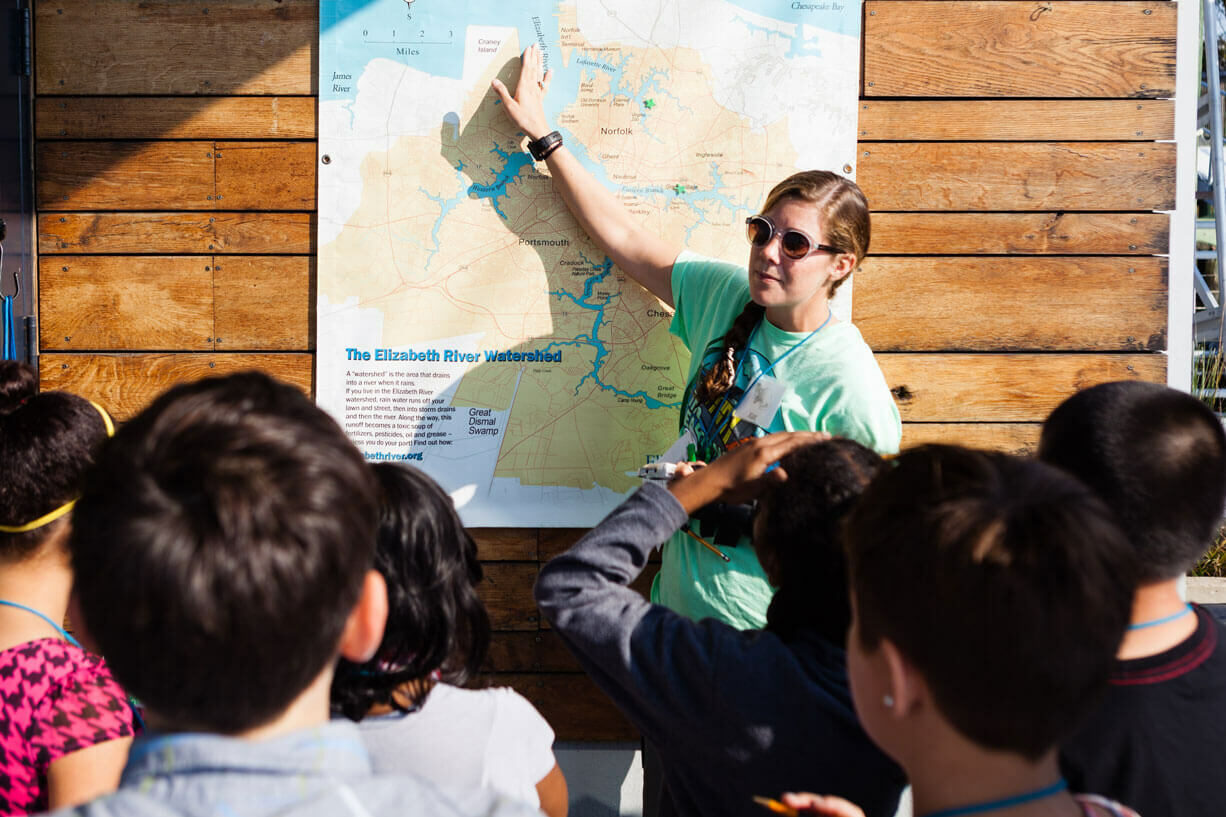
A watershed is an area of land that drains into a particular body of water like the Susquehanna River or the Chesapeake Bay.  When it rains all of the water that falls on the land has to go somewhere, so it drains off the land, our roadways and parking lots into local streams.  Threading through the Chesapeake watershed are more than 100,000 streams and rivers.  These streams then feed into large rivers such as the Susquehanna, Potomac and James.  All of these rivers eventually run into the Chesapeake Bay carrying with them any pollutants (like lawn fertilizer or oil from parking lots) that have washed off the land and other hard surfaces.

Why Should I Teach About Watersheds?

Understanding the links between what we do on the land and our waterways is the key to having healthy, safe rivers and a clean Chesapeake Bay.  Water is critical to all aspects of our lives.  Most of our drinking water comes from our local river so it is important that we understand the connections between people, land and waterways.  We are the source of all the solutions to problems that pollute our waterways.  Each and every person’s actions can and do have an impact on cleaning our own streams and rivers.

So How Do I Teach About Watersheds?

There are already tons of lessons and activities out there that teach about watersheds.  Here are a few of the best ones you can use in your classroom.  These include hands-on investigations that get students actively engaged in learning.

Krissy Hopkins is a former Chesapeake Bay Program Staffer and is currently pursuing her PhD in geology at the University of Pittsburgh.

Conservation Landscaping and Schoolyard Habitat Toolkits

February 19th, 2010 by Karen
Schoolyard Habitat Toolkit

Schoolyard Habitat Toolkit

As communities all across the Bay region are reexamining how to maximize the ecological potential of community spaces, the USFWS Schoolyard Habitat Partnership with the Maryland Association for Environmental and Outdoor Education and the NOAA Bay Watershed Education and Training Program releases the capstone toolkits of their 6-year partnership. These toolkits are designed to help project leaders access the best available resources to help create excellent Schoolyard Habitat and conservation landscaping projects.

Conservation landscapes are landscapes designed, planted and maintained to benefit people and the local ecosystem. The Toolkit for Conservation Landscaping for Community Spaces provides a framework for project designers to achieve a balance between ecologically significant landscaping and community engagement.

Excellent Schoolyard Habitat projects need support both with on-the-ground project implementation and classroom curricular-connections. The Schoolyard Habitat Program Development Toolkit enables providers of environmental education programs to more effectively assist schools in the development of sustainable, integrated schoolyard habitat projects.

These productions of the Schoolyard Habitat Partnership cannot be copied for resale however it can be copied for educational purposes.

Download the Toolkits

Karen Kelly Mullin is the Principal of the Willow Oak Group.

Snow No! A Rough Winter for the Chesapeake

February 10th, 2010 by Krissy
Satellite image of the Chesapeake region taken February 7th, 2010.  Photo Credit: NASA GSFC, MODIS Rapid Response

Satellite image of the Chesapeake region taken February 7th, 2010. Photo Credit: NASA GSFC, MODIS Rapid Response

February 2010 is one for the record books.  With nicknames like Snowmageddon, Snowpocalypse, and SnOMG the newspapers are deeming the blizzard that hit this month the end of the world.

The storm that dumped 30 plus inches on the Chesapeake region, almost overnight, can be seen from space thanks to NASA’s Wallops satellite.  This image, take on February 7th, 2010 shows the extent of the winter blast that pounded the area.

Snow extended north into New York, south into Virginia and blanketed the Eastern Shore with fresh powder.  The snow hides the large cities of Baltimore, Washington and Harrisburg, which are usually visible on satellite images as large grey patches. In this image, these major cities are blanketed under the snow hiding the impact we have on the landscape.

Along with being a striking way to view our region, this image also offers up a great learning opportunity for students, showing them how geography and the weather can influence our local waterways.

Can your students answer the following questions about this picture?

  1. Where is the mouth of the Chesapeake Bay and what body of water does it empty into?
  2. What long river runs south through New York and Pennsylvania and empties into the top of the Chesapeake Bay?
  3. Why do some of the rivers look brown in color while others appear bluish-green?
  4. What mountain range cuts through the left corner of this image?

If you have more questions submit them through our comments!

Additional Resources:
Daily Satellite Image of the Chesapeake Bay – NASA, MODIS Rapid Response
Weather Related Lesson Plans – Bay Backpack

Answers:

  1. The mouth of the Chesapeake Bay is in Virginia, where the Chesapeake Bay meets the Atlantic Ocean.
  2. The Susquehanna River, which runs for 444 miles from its source in Cooperstown, NY until it empties into the Chesapeake Bay at Havre de Grace, Md.
  3. Polluted water running off our roadways and parking lots drains into our rivers and streams and eventually the Chesapeake Bay. This polluted water appears brown in color because it is full of sediments and nutrients that wash off the land. Heavy rains and snow melt wash thousands of gallons of polluted water into the Bay each year.
  4. The Appalachian Mountains, which run from Newfoundland 1,500 miles south-west into Alabama. The Appalachians cut through all of the Chesapeake Bay watershed states but Delaware.
Krissy Hopkins is a former Chesapeake Bay Program Staffer and is currently pursuing her PhD in geology at the University of Pittsburgh.

Manassas Park Elementary School Goes Green

February 2nd, 2010 by Matt

Manassas Park Elementary School from Chesapeake Bay Program on Vimeo.

From a rainwater harvesting system to a light that tells children when the temperature is ideal outside for opening windows up, this school has thought of it all. Architects from VMDO teamed with Manassas Park Elementary School to build a structure that focuses on sustainable design through eco-friendly approaches. Please send this video to those you feel may be able to benefit from it. All videos produced for the Chesapeake Bay Program can be seen at the links below.

http://vimeo.com/chesapeakebay

http://www.youtube.com/user/chesbayprogram

Feel free to contact mrath@chesapeakebay.net with any questions or comments
Filed under: School Spotlight
Tags:
Matt Rath is Multimedia Specialist for the Chesapeake Bay Program. Producing videos, photos, and other web content for the Program and our partners.

Bay Backpack Launch Promotes Environmental Education

February 1st, 2010 by Krissy
Representative John Sarbanes boasts his support of the Bay Backpack, promoting citizen stewardship through our students.

Representative John Sarbanes boasts his support of the Bay Backpack, promoting citizen stewardship through our students.

Mike Land from the National Park Service delivers the Bay Backpack demo at the launch event.

Mike Land from the National Park Service delivers the Bay Backpack demo at the launch event.

From the historic McNasby’s Oyster Company building at the Annapolis Maritime Museum, the Chesapeake Bay Program announced the launch of Bay Backpack.  Over 40 folks packed into the bay room to hear officials, including Representative John P. Sarbanes and Annapolis Mayor Josh Cohen boast their support of Bay Backpack.

The event kicked off with Peyton Robertson, Director of NOAA’s Chesapeake Bay Office, officially announcing the launch of Bay Backpack.  He reflected on all the NOAA projects occurring in Annapolis, including the deployment of a CBIBS buoy in the Severn River and a new partnership through NOAA’s BWET Program that will allow the Annapolis Maritime Museum to  provide all elementary school students in the City of Annapolis with a Meaningful Watershed Educational Experience.  Peyton expressed Bay Backpack will allow teachers throughout the Chesapeake region to get their students outside too.  This tool provides teachers with the resources they need to integrate environmental education and Chesapeake Bay issues into their classrooms.  Bay Backpack covers all the bases: teaching resources,  field study programs, and training and funding opportunities.  It’s the whole package in one stop.

Annapolis Mayor Josh Cohen then offered his support of Bay Backpack.  Mayor Cohen was elated Bay Backpack will connect Annapolis teachers with resources to get their students outside.  Bay Backpack is a great project that will further Maryland’s Partnership for Children in Nature working to ensure all Maryland youth have the opportunity to learn about their environment and connect with the natural world.

Representative John Sarbanes spoke next,  noting citizen stewardship is the only way we are going to save the bay.  By educating and engaging our youth, through the MWEE process, we are building a sustainable future for the Chesapeake region. We are educating the next generation of Bay stewards who will care for and protect this national treasure.  He was delighted to offer is support of Bay Backpack and environmental education throughout the region.

Rebecca Bell, from the Maryland State Department of Education added this tool will help the state of Maryland achieve its goal of providing every student with a Meaningful Watershed Educational Experience or MWEE every year.  Students who receive these experiences are the ones who go on to become environmentally conscious business owners and executives.  Rebecca was happy to offer the support of the Maryland State Department of Education to get this tool into every classroom in Maryland.

The event closed with a demonstration of Bay Backpack by Mike Land with the National Park Service.  Mike walked the group through each of the sections of Bay Backpack and encouraged everyone to spread the word about the site.  Tell other parents, tell your friends and most importantly tell your kid’s teacher.  Follow Bay Backpack on Twitter @baybackpack or become a fan on Facebook.

Help us spread the word!

Filed under: News
Tags:
Krissy Hopkins is a former Chesapeake Bay Program Staffer and is currently pursuing her PhD in geology at the University of Pittsburgh.